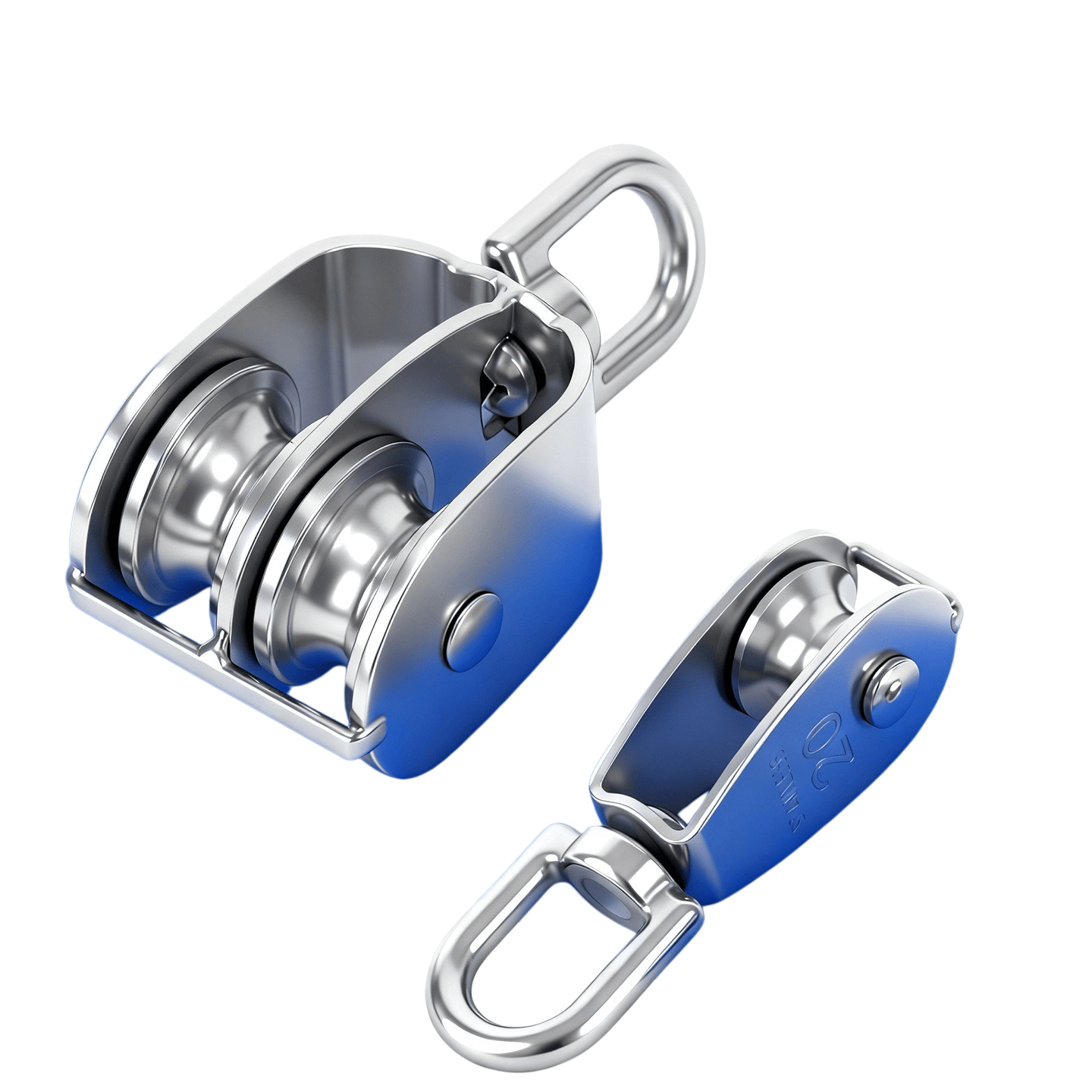
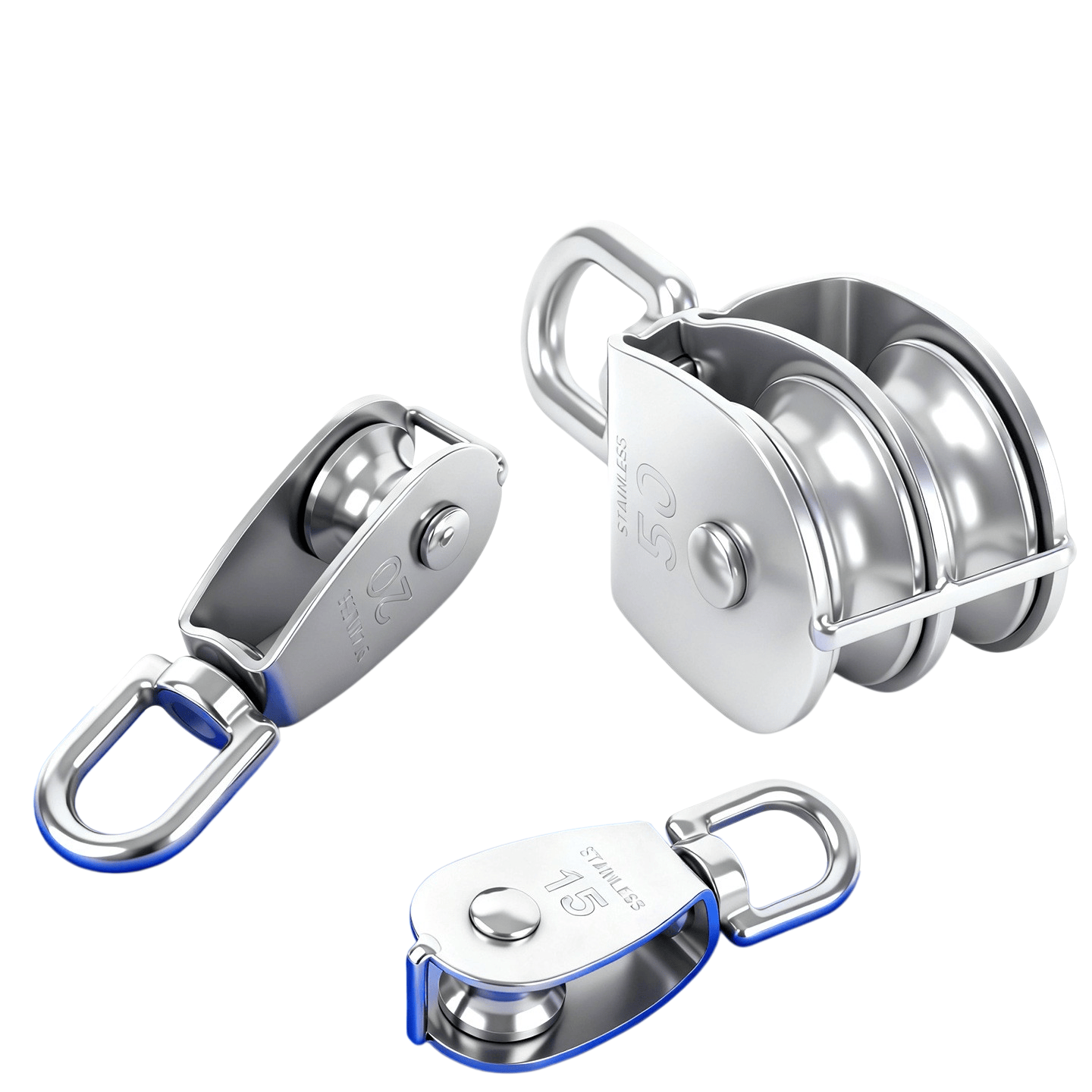
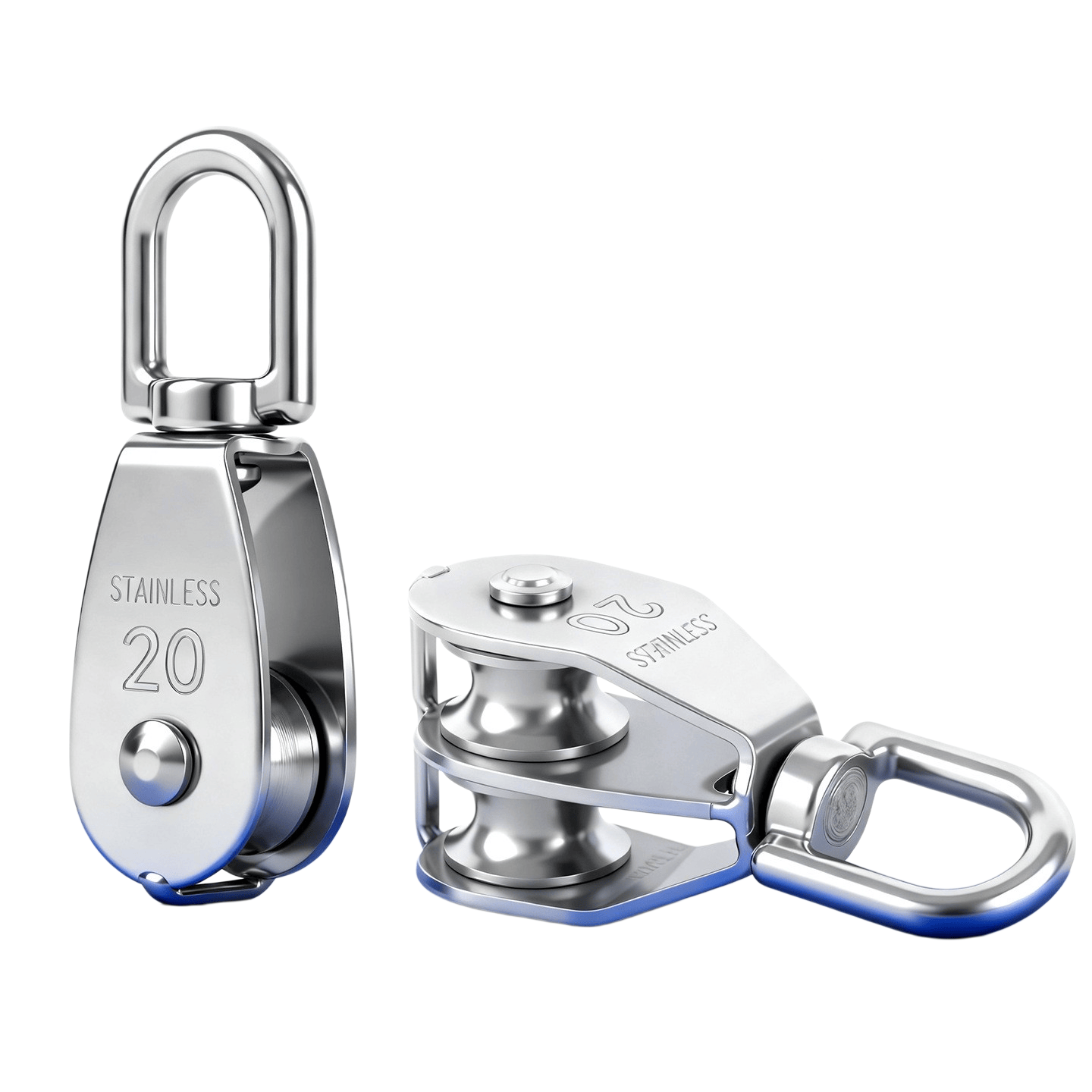
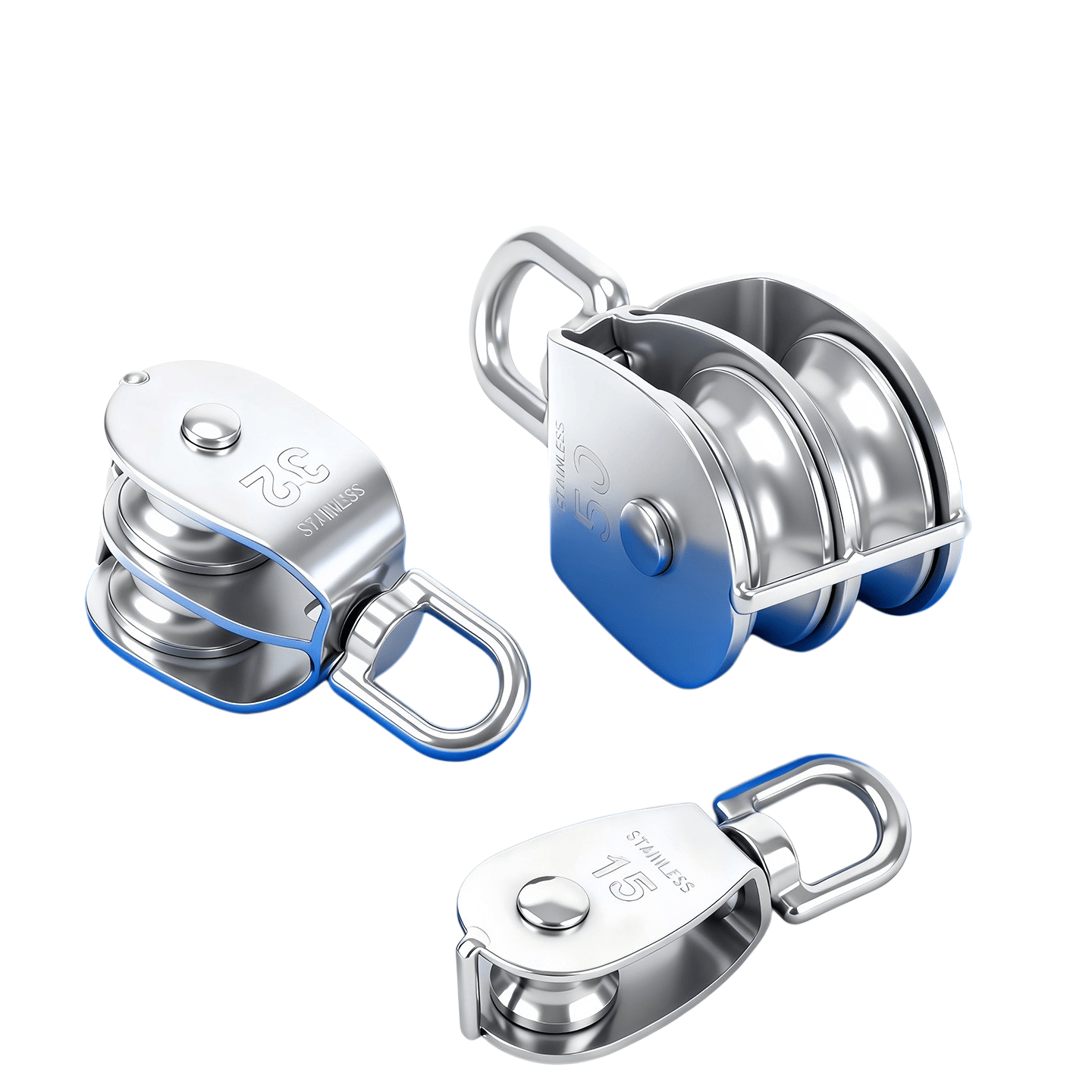
Stainless steel pulley blocks can be supplied for marine hardware, outdoor equipment and industrial rope-routing assemblies. Single-sheave, double-sheave and swivel configurations can be reviewed from drawings or samples, with SS304 or SS316 material, sheave profile, pin structure, attachment method and surface finish confirmed for the intended project.
This page describes an OEM supply service rather than a certified load rating. Buyers should provide the rope or wire-rope diameter, required working load, mounting arrangement, duty cycle, environment and verification documents before product suitability is confirmed.
Stainless Steel Pulley Block Product Overview
A stainless steel pulley block guides a rope or wire rope around a sheave so the line can change direction within an assembly. The block body, sheave, pin, swivel or bracket must work together with the selected line and mounting point. A visual match is not enough for an industrial purchase: the drawing should identify the critical dimensions, material, connection geometry and required verification.
Youjia Metals supports OEM and bulk enquiries for standard-looking and drawing-based pulley hardware. The available manufacturing route is reviewed after the structure and quantity are known. Depending on the design, components may involve casting, stamping, machining, turning, drilling, polishing and assembly. These processes are not promised for every design; the final route is selected during drawing review.
Single, Double and Swivel Pulley Block Options
Single-Sheave Block
A compact option for changing line direction in a simple rope path. Confirm sheave diameter, groove profile, pin diameter, body width and attachment point.
Double-Sheave Block
Two sheaves may be used in a multi-line arrangement. The buyer should provide the complete reeving layout rather than ordering from the outside appearance alone.
Swivel-Eye Configuration
A swivel connection can allow the block orientation to follow the line path. Rotation range, pin retention and attachment geometry must be confirmed on the approved drawing.
Bracket or Removable-Pin Design
Bracket mounting or removable pins may simplify installation in specific equipment. Hole position, pin locking method and access clearance are project-specific.
Custom Pulley Block Specifications
| Specification Item | Information Required for Review |
|---|---|
| Material | SS304, SS316 or another confirmed grade; material certificate requirements must be stated in the RFQ. |
| Block Type | Single sheave, double sheave, swivel eye, fixed bracket, removable pin or drawing-based design. |
| Rope / Wire Rope | Material, nominal diameter, construction and minimum bending requirement supplied by the buyer. |
| Sheave | Outside diameter, groove radius/profile, groove width, bore, bearing or bushing requirement and material. |
| Body and Pin | Overall dimensions, plate/body thickness, pin diameter, retention method and assembly clearance. |
| Surface Finish | Polished, matte, passivated or project-specific finish, subject to material and appearance review. |
| Load Information | Required working load, design factor, direction of loading, duty cycle and proof/break test requirements. |
| Inspection | Dimensional report, material document, finish check, functional rotation check or specified third-party test. |
| Quantity | Prototype, trial batch or production quantity with required delivery schedule. |
| Drawing Format | PDF, DWG, DXF, STEP or IGS where available; final acceptance follows the approved revision. |
Unknown values should be marked “to be confirmed” rather than estimated. A complete specification allows the supplier to assess tooling, process, inspection, packaging and lead time without creating false assumptions.
SS304 and SS316 Material Options
SS304 stainless steel pulley blocks may be considered for many general industrial, outdoor and fresh-water environments. SS316 stainless steel pulley blocks contain molybdenum and are often evaluated where chloride exposure is more demanding. Material selection still depends on temperature, cleaning chemicals, crevices, maintenance and expected service life.
Neither grade is universally “rust-proof.” Deposits, stagnant salt water, incompatible chemicals, contamination and poor cleaning can affect surface condition. If grade selection is uncertain, review our guide to SS304 vs SS316 stainless steel hardware and provide the actual exposure conditions with the enquiry.
Surface appearance and corrosion performance are separate purchasing points. A polished finish may improve cleanability or appearance, while passivation requirements should be clearly specified. The finish cannot replace correct grade selection or routine maintenance.
Sheave Diameter, Groove and Rope Compatibility
The sheave must be compatible with the intended rope or wire rope. Buyers should not select a pulley solely by overall block size. The groove profile should support the line without excessive pinching, flattening or side loading. The sheave diameter also influences bending of the line, but the acceptable ratio depends on the rope construction and its manufacturer’s guidance.
- Rope diameter: provide the nominal size and tolerance.
- Rope construction: fibre rope, stainless wire rope and other constructions have different requirements.
- Groove geometry: state groove radius, width and finish where these are critical.
- Fleet angle and alignment: provide the complete routing layout when side loading is possible.
- Rotation system: specify plain bore, bushing or bearing requirements instead of assuming smoothness from a photograph.
A buyer replacing an existing block should submit the old part drawing or measured dimensions, plus photographs of the mounting and rope path. Wear on the old component may mean that direct copying is not appropriate without engineering review.
Marine, Outdoor and Industrial Applications
A marine stainless steel pulley block may be evaluated for deck hardware, rope guidance, shade systems, outdoor equipment and other assemblies exposed to moisture. Industrial buyers may use pulley hardware in machinery guards, adjustable fixtures, access systems, cable routing or equipment mechanisms. The exact application must be disclosed because environment and load direction affect the specification.
Terms such as “marine grade,” “heavy duty” and “lifting pulley” are not substitutes for engineering data. Where the product supports a safety-critical load, the buyer must identify the governing standard, test level, marking, traceability and acceptance documents. Youjia Metals will not assign an unverified rating from a similar-looking product.
Related components can be sourced through our stainless steel rigging hardware category. For rope and chain assemblies, see our stainless steel welded chain product page and the guide to short-link vs long-link chain.
Manufacturing, Assembly and Quality Inspection
The manufacturing plan begins with a drawing review. Critical characteristics may include sheave concentricity, groove profile, body clearance, pin fit, swivel movement, attachment-hole position and surface condition. Inspection depth depends on the order requirements and should be agreed before production.
Possible control steps include incoming material verification, first-article dimensional checks, in-process checks, assembly movement inspection, finish inspection and final packaging review. If a buyer requires chemical composition reports, dimensional records, proof testing, break testing, salt-spray testing or third-party inspection, those requirements must be listed before quotation. Availability, sampling method and acceptance criteria are confirmed project by project.
For non-standard brackets, pins and related pieces, buyers can also review our custom hardware parts capability. Internal links between the pulley block, rigging category and custom component pages help purchasers navigate by both product type and manufacturing need.
OEM Pulley Block Manufacturing Process
- Submit requirements: send the drawing, sample photographs, application, line specification, quantity and destination.
- Technical review: confirm material, dimensions, attachment, sheave structure, load information, finish and documents.
- Quotation: tooling, unit cost, sample plan, inspection, packaging and lead time are quoted after the specification is sufficiently clear.
- Sample approval: where required, inspect the sample against the approved drawing before authorizing a production batch.
- Production and inspection: manufacture to the released revision and complete the agreed checks.
- Packaging and delivery: use the approved packing method and label each batch with the agreed identification.
Changes after drawing approval can affect tooling, cost and delivery. Maintain a clear revision number and avoid combining dimensions from several unverified samples.
Packaging, Bulk Supply and RFQ Checklist
Packaging is selected according to part size, finish, shipment method and buyer labeling requirements. Options can be reviewed for individual protection, inner cartons, master cartons, pallets or other export packaging. Availability and cost are confirmed with the quotation; no fixed stock or same-day shipment is implied.
Send These Details for a Useful Quotation
- Block type and drawing revision
- SS304, SS316 or required material specification
- Rope or wire-rope diameter and construction
- Sheave diameter, groove and pin details
- Mounting or swivel configuration
- Working load, design factor and load direction
- Application and exposure environment
- Required inspection and test documents
- Prototype and production quantities
- Packaging, destination and requested delivery date
Frequently Asked Questions
Can you manufacture a custom stainless steel pulley block from a drawing?
Yes, drawing-based configurations can be reviewed. Please include dimensions, material, rope data, load requirements, attachment details, quantity, finish and required inspection documents.
Do you supply both SS304 and SS316 pulley blocks?
SS304 and SS316 can be reviewed, subject to structure, material availability and order requirements. The final grade should match the actual environment rather than a generic “marine grade” label.
Can you confirm a safe working load from a photograph?
No. A working load cannot be assigned from appearance alone. The complete design, materials, manufacturing route, load direction, safety factor and test requirements must be reviewed.
What information is needed to select the sheave?
Provide rope or wire-rope type, diameter, construction, routing, required sheave diameter, groove geometry, rotation system and duty conditions.
Are these pulley blocks suitable for overhead lifting?
Not unless the exact product has been engineered, tested, marked and documented for that use under the applicable requirements. General rope-routing hardware should not be assumed suitable for lifting people or overhead loads.
What is the MOQ and lead time?
MOQ and lead time depend on tooling, material, quantity, inspection and packaging. They are confirmed after the drawing and RFQ details are reviewed.
Request a Stainless Steel Pulley Block Quote
Send the drawing, rope specification, working-load requirement, material grade, quantity and required documents. Our team will review the configuration before confirming manufacturability and quotation terms.
Send Your Drawing View Rigging Hardware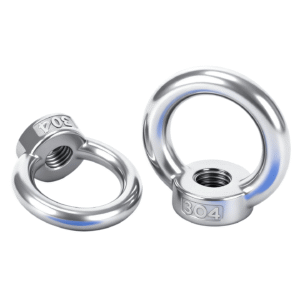
Reviews
There are no reviews yet.