
Choosing between short link vs long link stainless steel chain is not simply a matter of appearance. Link proportions affect how a chain bends, how much it weighs per metre, which hooks or shackles can pass through the opening, and whether it can run through a particular guide or pocket. Two chains can share the same wire diameter and stainless grade yet behave very differently because their pitch and inside width are different.
This buyer guide explains the comparison from a purchasing and specification perspective. It is intended for industrial buyers, fabricators, marine-equipment suppliers, distributors, and OEM teams that need to describe the required chain clearly. It does not assign a working load or claim that a general-purpose chain is suitable for lifting. If an assembly is safety-critical, the governing standard, product rating, testing, marking, and documentation must all be confirmed for the exact item.
Definitions: Short Link and Long Link Chain
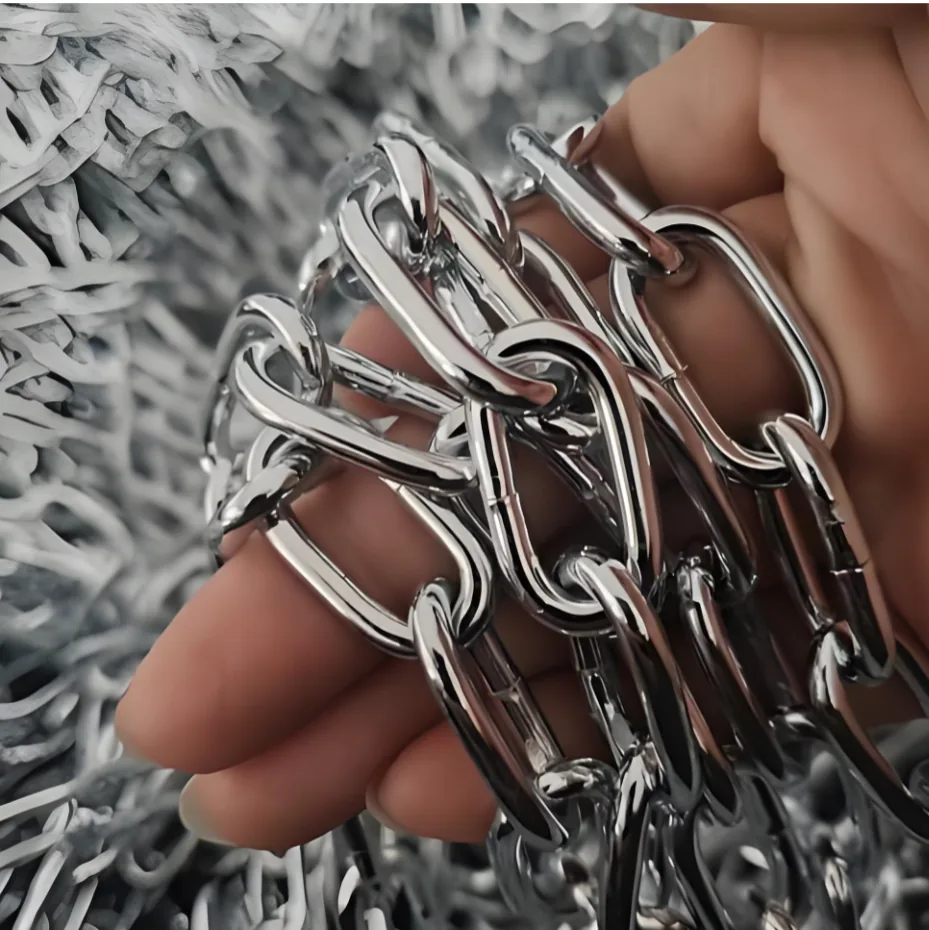
A short link chain uses relatively compact links. Compared with a long link chain made from the same nominal wire diameter, it normally has a shorter pitch and more links in a given length. The smaller opening can help create controlled articulation, reduce the space available for an object to pass through a link, and provide a compact form for machinery, restraints, or marine assemblies. However, the words “short link” alone do not establish a dimensional standard. A buyer still needs an actual drawing, dimensional table, approved sample, or referenced specification.
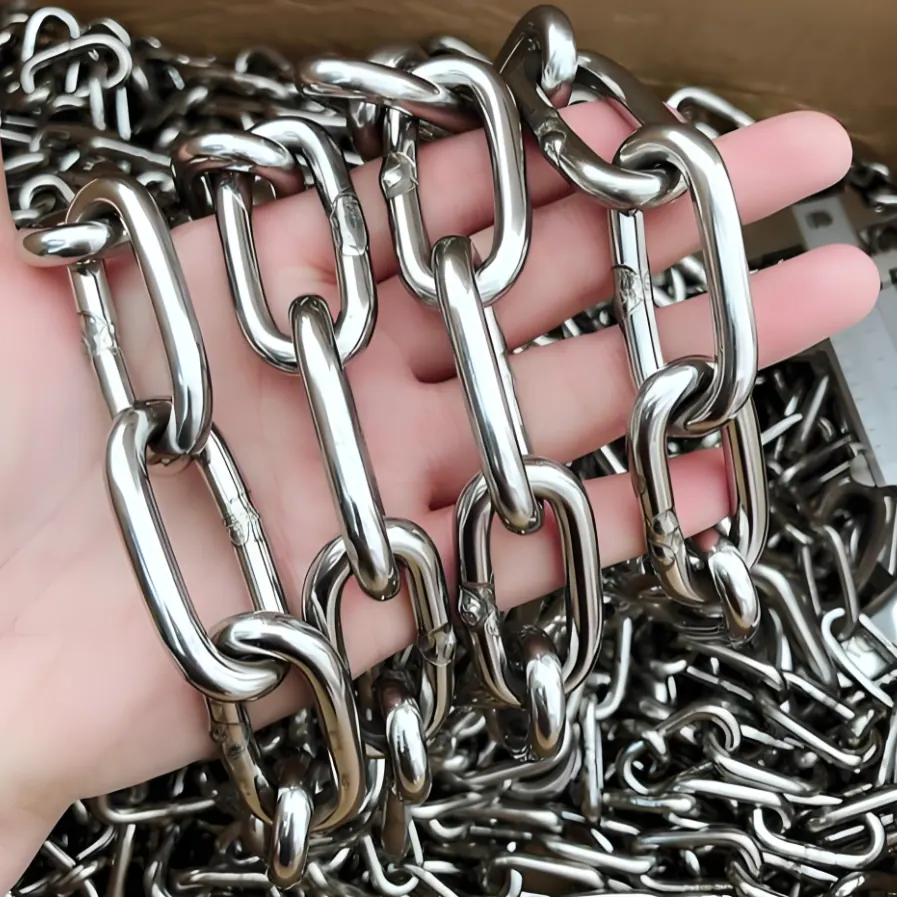
A long link chain uses more elongated links, with a greater inside length and often a more open visual profile. Fewer links are needed per metre, so it may use less material over the same finished length when the wire diameter and other variables are comparable. The larger opening can make attachment and adjustment easier because a compatible hook, shackle, quick link, pin, or other connector has more room to enter the link.
Neither form is universally better. Short link chain is often chosen when compact geometry, smoother bending, or equipment compatibility matters. Long link chain is often selected when the buyer wants a larger opening, easier attachment, lower mass, or an open architectural appearance. The decision should follow the application and mating components, not a general rule.
Key Dimensional Differences
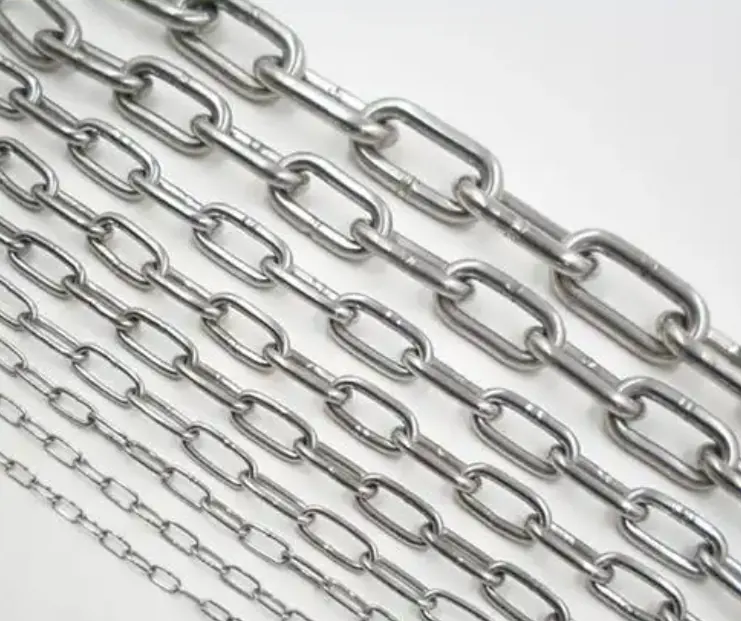
Three dimensions provide a practical starting point: wire diameter, pitch, and inside width. Wire diameter describes the thickness of the round material forming the link. Pitch is commonly understood as the repeating length from one corresponding point on a link to the same point on the next link, although drawings should state the exact measurement convention. Inside width is the clear opening across the link. Some specifications also show outside length, outside width, or inside length. These values are related, but they are not interchangeable.
Short links have a smaller pitch-to-diameter relationship than long links. That is the geometric difference behind many of their practical characteristics. More links are required to make one metre, which generally increases weld count and material mass per finished length. Long links spread each repeat over a greater distance. That can reduce the number of links and produce a lighter chain, but it also creates a larger opening and changes how the chain folds or contacts a surface.
Nominal size is not enough for a purchase order. A label such as 6 mm chain may describe wire diameter while saying nothing reliable about inside length or width. If a connector must pass through the link, if the chain must sit inside a guide, or if a finished assembly has a strict envelope, include the required clear dimensions and tolerances. The stainless steel welded chain specifications page provides a useful starting point for discussing the dimensional fields that belong on an RFQ.
How to Measure Wire Diameter, Pitch, and Inside Width
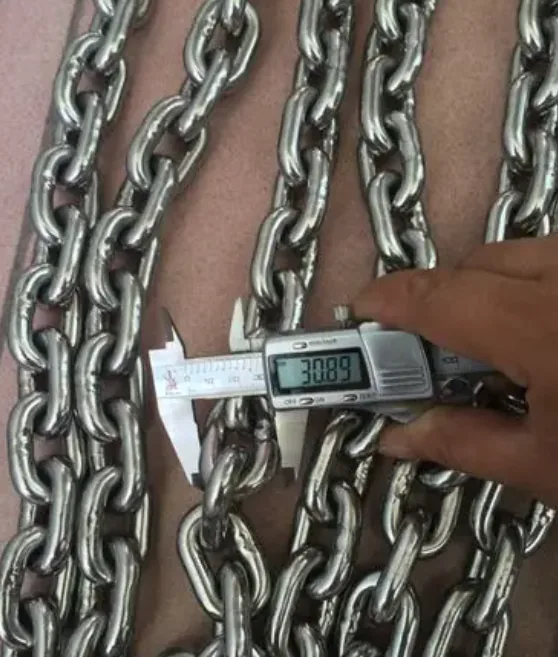
Measure a clean, straight section that is free from obvious deformation. Do not take a reading over the weld because the local profile may be larger than the parent wire. For wire diameter, place a suitable caliper across an unworn straight portion of the link. Measure more than one link and more than one orientation if the chain is used or if the section is not perfectly round. Record the instrument resolution and the measurement location when the value will be used for acceptance.
For inside width, close the jaws lightly against the narrowest clear opening without forcing the link out of shape. The measurement needs to represent the space available to a mating part. If a hook, pin, or shackle has a critical dimension, compare actual components or controlled samples rather than relying only on nominal catalog values. Clearance is needed for assembly, surface finish, tolerances, and real operating movement.
Pitch should be checked over several links when possible. Measuring a longer span and dividing by the number of repeats can reduce the influence of a single irregular link. Keep the chain under only enough tension to remove slack unless the applicable inspection method states otherwise. Photographs should show the measuring points clearly. See the detailed guide on how to measure stainless steel chain dimensions before sending a replacement-chain enquiry.
Short Link vs Long Link: Buyer Comparison
| Purchasing factor | Short link chain | Long link chain |
|---|---|---|
| Link form | Compact repeat with smaller opening | Elongated repeat with larger opening |
| Links per metre | Usually more at the same wire diameter | Usually fewer at the same wire diameter |
| Weight per metre | Often higher when other variables are comparable | Often lower when other variables are comparable |
| Attachment access | Clear opening may limit connector size | Larger opening can simplify attachment and adjustment |
| Bending behaviour | Generally articulates through shorter increments | Longer links can create a larger folded envelope |
| Equipment fit | Must match specified pockets, guides, or wheels | Must not be assumed compatible with short-link equipment |
| Common purchasing focus | Pitch control, compact geometry, dimensional consistency | Opening size, weight, attachment convenience, appearance |
The table describes tendencies, not guaranteed performance. Actual weight depends on the complete geometry, material density, weld profile, dimensional tolerance, and finished length. Strength depends on far more than link length. Stainless grade, wire diameter, manufacturing route, weld integrity, heat treatment where applicable, test method, and load direction all matter. A short link should not automatically be described as stronger, and a long link should not automatically be described as weak.
Flexibility, Bend Radius, and Weight per Metre
Chain flexibility is the result of articulation between individual links. A short link chain has more articulating joints in each metre, so it can often follow a tighter path and form a more compact pile. That can be useful where storage space is limited or where a chain needs to pass through a controlled route. It does not mean every short link product will run correctly on a wheel. Equipment-driven applications require matched geometry and, where specified, calibrated dimensions.
Long link chain bends at fewer points along the same length. Each link presents a longer rigid segment, which may make the chain less comfortable around a small radius or inside a compact enclosure. The form can nevertheless be convenient for suspended barriers, hanging components, architectural assemblies, and situations where attachment anywhere along the chain is valuable.
For freight and installation planning, ask the supplier for the expected mass per metre for the offered construction. Do not estimate a purchasing quantity from wire diameter alone. On a long run, a modest difference in mass per metre changes coil weight, manual handling, support requirements, and shipping cost. Compare quotations only after confirming that material grade, wire diameter, link dimensions, finish, tolerance, unit length, and documentation requirements are equivalent.
Connection Hardware Compatibility
The chain is only one part of an assembly. Hooks, shackles, swivels, quick links, eye bolts, turnbuckles, pins, guides, and brackets must fit the actual opening and must articulate without binding. A connector that technically enters a link may still be unsuitable if its body bears on the weld, crowds the neighbouring link, or creates side loading. Check the connector body as well as its pin or throat dimension.
Long links usually provide more access for general-purpose attachment. That can make field adjustment easier: a suitable connector may be installed at different positions without a dedicated shortening device. The larger opening can also accommodate broader components. Short links offer less open space, so the mating part and the required clearance need closer attention. Their compact geometry can be advantageous when a small opening is part of the restraint design.
When replacing an existing chain, send photographs of both the chain and every mating component, plus measured dimensions. If a wheel, pocket, guide, or powered mechanism is involved, provide the equipment drawing or manufacturer reference. Never substitute a chain based only on visual similarity. Buyers can review the available rigging hardware category to identify related components, but each component still requires its own suitability review.
SS304 and SS316 Selection
SS304 stainless steel chain is widely used for indoor, outdoor, architectural, food-handling, and general industrial environments where broad corrosion resistance is required. It is often the economical starting point for a stainless assembly. The surrounding chemicals, cleaning process, temperature, surface contamination, and maintenance schedule still need consideration. Stainless steel is corrosion resistant, not corrosion proof.
SS316 stainless steel chain contains molybdenum and generally offers better resistance in chloride-bearing and coastal environments. It is frequently requested for boats, docks, waterfront equipment, and certain processing environments. Yet grade selection cannot be reduced to “316 for all outdoor use.” Crevices, deposits, stagnant water, dissimilar-metal contact, and cleaning practices can change service behaviour. A severe chemical environment may require a more specific materials review.
Specify the grade on the drawing, quotation, purchase order, and inspection documents. Do not accept “stainless steel” as the complete material description when grade matters. If verification is required, state the expected document or test method in the enquiry rather than asking for it after production. The comparison of SS304 vs SS316 stainless steel chain gives additional context for corrosion-focused purchasing decisions.
Marine and Coastal Applications
Marine exposure combines chlorides, moisture, deposits, and often limited access for cleaning. Link intersections and weld areas can retain contamination, while contact with other metals can create unfavourable galvanic conditions. Grade 316 is commonly preferred, but design and maintenance remain important. Rinsing, inspection, ventilation, drainage, and compatible fittings can matter as much as the grade printed on a purchase order.
Short link chain may be selected for compact storage, controlled handling, or compatibility with a specified marine mechanism. Long link chain may be useful for deck barriers, hanging accessories, or non-critical connections where a large opening simplifies assembly. These examples do not establish that a chain is anchor rated, lifting rated, or approved for personnel protection. Those claims require a defined product specification and supporting evidence.
For a coastal enquiry, describe whether exposure is occasional splash, salt spray, tidal immersion, or continuous immersion. Note cleaning chemicals, expected service temperature, mating metals, and inspection access. Read the application overview for stainless steel chain for marine use, then include the actual environment in the RFQ so the supplier can review it.
Industrial, Architectural, and General-Purpose Uses
Industrial buyers use welded stainless chain for guards, access control, machine restraints, washdown areas, suspended components, and custom assemblies. Short links can provide a compact shape and frequent connection points. Long links can reduce mass and give installers a larger opening. The correct style depends on motion, contact surfaces, cleaning conditions, mating parts, and the consequence of failure.
Architectural projects often consider appearance alongside function. Long links create an open rhythm suitable for boundaries, hanging displays, lighting, planters, and decorative features. Short links appear denser and may suit compact restraints or designs where a smaller opening is preferred. Surface finish, weld appearance, straightness, and colour consistency should be agreed using a sample when the chain will remain visible.
General-purpose chain must not be promoted into a safety-critical role without evidence. Overhead lifting, fall arrest, suspension above occupied spaces, and other high-consequence uses require products designed and documented for those duties. If the proposed use involves people, valuable equipment, dynamic loading, or regulatory inspection, identify the governing requirements before requesting a price.
Short Link Purchasing Checklist
- Application: explain whether the chain is for a barrier, restraint, marine assembly, machine, architectural feature, or another purpose.
- Material: state SS304, SS316, or the required stainless designation.
- Wire diameter: provide the value and tolerance if controlled.
- Pitch and opening: give inside length, inside width, or a fully dimensioned drawing.
- Equipment interface: identify any wheel, guide, pocket, tube, or enclosure.
- Finish: describe the required surface condition and any appearance standard.
- Length format: state continuous length, cut lengths, assemblies, or coil preference.
- End fittings: provide drawings or samples for welded or assembled components.
- Inspection: list dimensional checks, material documents, or other agreed records.
- Quantity and delivery: give trial quantity, production quantity, destination, and packaging constraints.
For short links, dimensional consistency deserves special attention when the chain interfaces with equipment. If a calibrated product is required, say so explicitly and identify the applicable specification and matching system. Do not assume that every compact-link chain is calibrated merely because it resembles an equipment chain.
Long Link Purchasing Checklist
- Confirm the clear opening needed for the largest connector body, not only its pin.
- State the preferred mass per metre only as a controlled requirement when supported by agreed dimensions.
- Define acceptable link proportions using a drawing rather than the phrase “long link” alone.
- Check how the elongated links fold, twist, and contact supports in the installed arrangement.
- Identify whether users will attach hardware at arbitrary points along the chain.
- Specify cosmetic expectations for visible architectural or retail installations.
- State cut-length tolerance and whether end links require a particular orientation.
- Confirm packaging that prevents tangling, surface damage, or mixed lengths.
Long link quotations can look economical because fewer links may be required per metre, but price should not be the only comparison. Check the offered grade, wire diameter, inside dimensions, finish, weld quality, length tolerance, packaging, and records. A lower-mass construction may change handling and attachment behaviour, so review the complete assembly.
Custom Dimensions and OEM Supply
OEM projects may need a link shape that does not match a standard catalog item. The buyer should provide a controlled drawing showing wire diameter, inside length, inside width, outside envelope where important, weld location, surface finish, overall length, and tolerances. Add the application and mating-part drawings so manufacturability can be reviewed in context.
A sample is useful when appearance, articulation, or equipment fit is difficult to express on paper. The approved sample should be tied to a drawing revision and inspection criteria. It should not replace measurable requirements. If the chain is part of a welded assembly, identify orientation, fixture points, heat-affected appearance, and dimensions that must be maintained after joining.
For a custom OEM stainless steel chain enquiry, separate mandatory requirements from preferences. That helps the supplier evaluate tooling, tolerances, material availability, and practical inspection methods without guessing. You can also review the existing stainless steel welded link chain product page before sending a drawing.
Inspection and Purchasing Documents
An inspection plan should match the risk and the purchase specification. Common checks include wire diameter, inside width, inside length or pitch, overall cut length, surface condition, weld appearance, quantity, and packaging identification. The plan should state sample size, measuring method, acceptance criteria, and responsibility. Vague requests such as “full inspection” are difficult to price and may not cover the buyer’s actual concern.
Document needs must be stated before quotation. A buyer may require a material document, dimensional report, certificate of conformity, packing list, or agreed test record, but availability and content must be confirmed for the exact order. Do not assume that a generic website statement proves compliance for a specific batch. Likewise, do not request a certification name unless it is relevant to the application and purchasing contract.
When load data is required, identify the test method, sample preparation, acceptance value, reporting units, and whether destructive testing is permitted. General-purpose chain should not receive an invented working load based on a similar-looking product. Any rating must belong to the exact construction and be supported by the required technical basis.
Packaging, Lengths, and Bulk Orders
Packaging affects both freight and usability. Chain may be supplied in coils, reels, cut lengths, bundles, or assemblies depending on size and order requirements. The RFQ should state maximum package weight, preferred unit length, labelling, pallet restrictions, corrosion-protection expectations, and whether individual lengths must remain separated. Stainless surfaces can still be scratched or contaminated during transport.
For bulk stainless steel chain orders, ask how length tolerance will be controlled and reported. Confirm whether quantity is purchased by piece, metre, or weight, and define how any conversion will be handled. If multiple sizes or grades share a shipment, require clear package identification to reduce receiving errors. Destination details matter because pallet dimensions, moisture protection, and documentation can vary by route.
A practical sequence is to approve dimensions and appearance on a sample, place a controlled trial order, inspect the received material in the real assembly, and then release the production quantity. This does not eliminate the need for a clear specification, but it exposes connection or handling issues before a larger purchase.
How to Write a Clear RFQ
Start with one sentence describing the application and environment. Then list stainless grade, wire diameter, link dimensions, total quantity, length format, finish, mating components, and documentation. Attach a drawing in a controlled file format and include revision status. If the request is a replacement, add photographs with a scale and identify which dimensions were measured.
State whether the chain is general purpose or subject to a particular standard. If no safety rating is required, avoid ambiguous language that could cause a supplier to assume one. If a rating is required, name the duty, governing requirements, and evidence expected. Provide expected static, dynamic, shock, or cyclic conditions to the qualified engineering team responsible for the assembly.
Finally, state delivery destination, target schedule, packaging limits, and whether the quotation should separate tooling, samples, inspection, and production. Clear information allows suppliers to compare the same scope. For a quotation or dimensional review, use the Youjia Metals contact page and attach the relevant drawing or product photographs.
Frequently Asked Questions
What is the main difference between short link and long link stainless steel chain?
The main difference is link proportion. Short link chain has a more compact pitch and normally more links per metre. Long link chain has a more elongated opening and normally fewer links per metre when wire diameter is comparable. Actual dimensions must still be confirmed.
Is short link stainless steel chain stronger than long link chain?
Not automatically. Strength depends on material, wire diameter, link geometry, weld integrity, manufacturing specification, test method, and load direction. Link style alone cannot establish a working load or suitability for lifting.
Which chain is easier to connect with hooks or shackles?
Long link chain often provides a larger opening, which can make attachment easier. Compatibility must be checked with the complete connector body and required movement, not just the nominal pin diameter.
Which link style is lighter per metre?
Long link chain is often lighter when compared with short link chain of the same wire diameter and material because it may contain fewer links per metre. Request the actual mass for the offered dimensions rather than relying on this tendency.
Should I choose 304 or 316 stainless steel?
304 suits many general industrial and architectural environments. 316 is commonly preferred where chloride or coastal exposure is more demanding. The complete environment, maintenance, mating materials, and service consequence should guide selection.
Can any stainless steel chain be used for lifting?
No. A general-purpose welded chain must not be used for overhead lifting, fall protection, or another safety-critical duty unless the exact product is designed, tested, marked, and documented for that purpose under the applicable requirements.
What dimensions should be included in an order?
Include wire diameter, pitch or inside length, inside width, overall length, tolerance, grade, finish, quantity, and any mating-component constraints. A drawing is preferable when dimensions are critical.
Can Youjia Metals review a custom chain drawing?
Youjia Metals can review an enquiry that includes dimensions, material grade, application, quantity, finish, packaging, and inspection requirements. Feasibility and supply terms should be confirmed against the submitted drawing rather than assumed from a general page.
Final Selection Summary
Choose short link stainless steel chain when compact geometry, frequent articulation, a smaller opening, or compatibility with a specified system is the priority. Choose long link stainless steel chain when a larger opening, easier attachment, lower mass, or an open visual form better suits the project. In both cases, specify the complete dimensions and mating components.
The safest purchasing decision is based on a drawing, application description, environment, inspection plan, and agreed documentation. Do not infer certification, capacity, or equipment compatibility from link shape. A precise RFQ turns the short-link-versus-long-link question into a controlled engineering and sourcing decision.