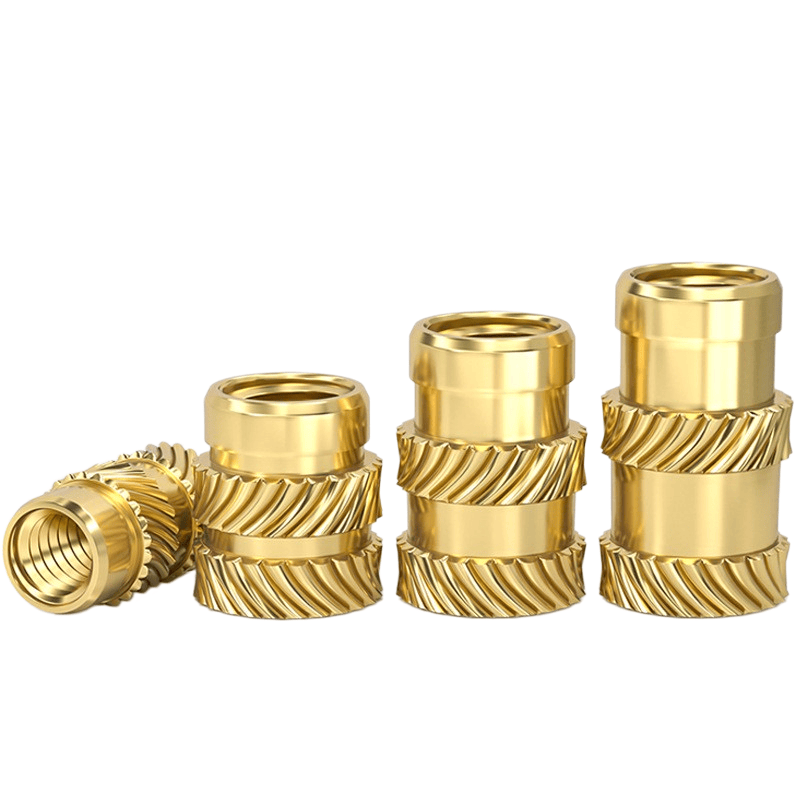
Brass Threaded Inserts – Heat Set / Ultrasonic / Knurled
Premium Threaded Inserts for Plastics | Quality documentation subject to confirmation

Product Overview
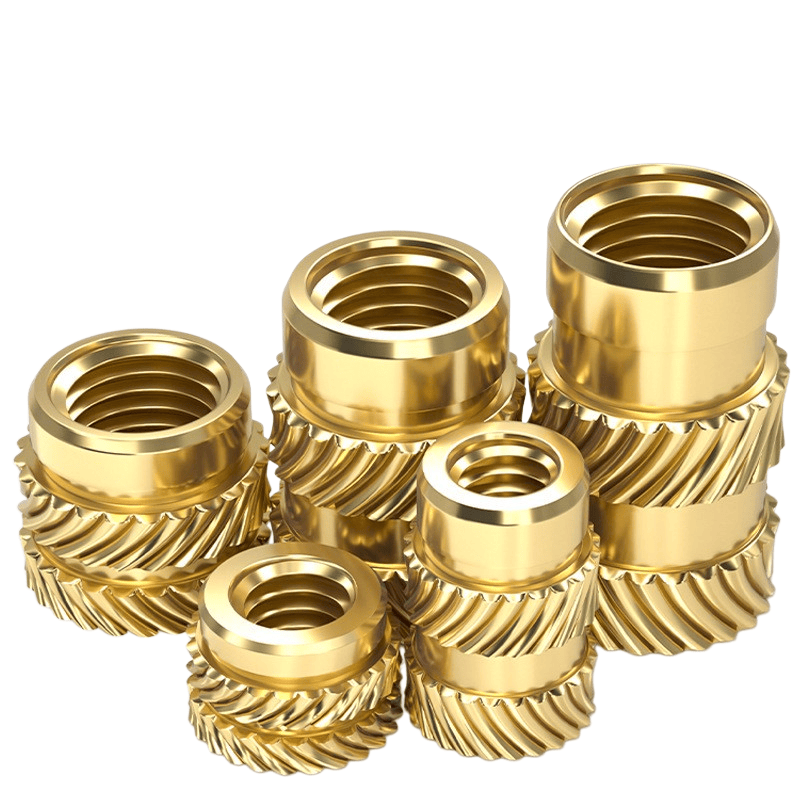
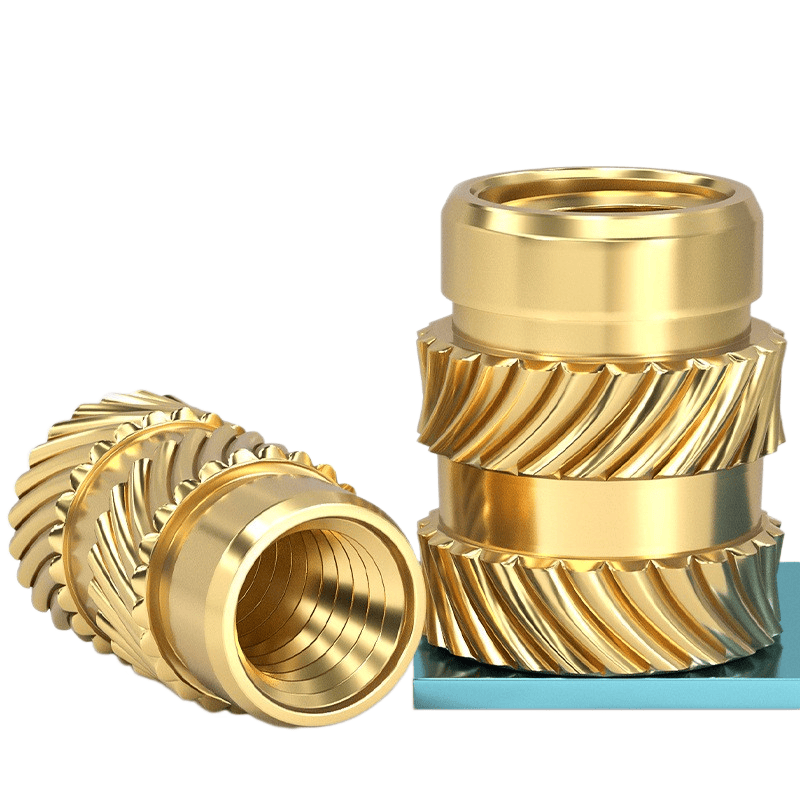
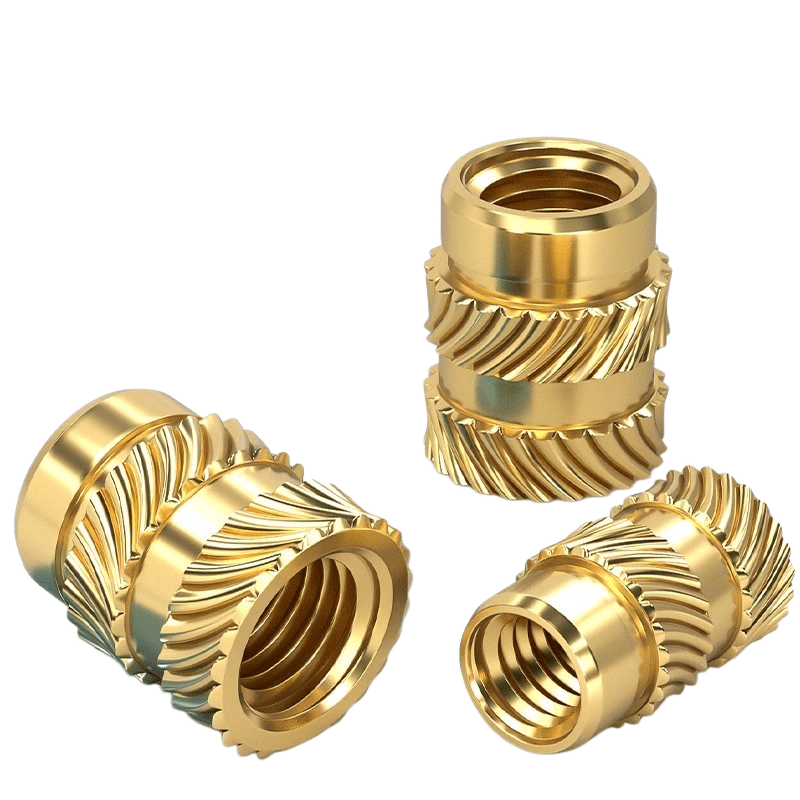
Our Brass Threaded Inserts are specifically designed to provide strong, permanent threads in plastic parts. Whether you are working with 3D printed components (PLA, PETG, ABS) or industrial injection molding, these heat-set inserts ensure a rock-solid connection. The opposing diagonal knurl design provides high torque-out and pull-out resistance, making them far superior to standard threaded nuts.
Unlike self-tapping screws that create weak threads in plastic, our threaded inserts for plastics create a metallurgical bond between the brass insert and the surrounding plastic material. This results in connections that can withstand repeated assembly and disassembly without degrading the thread quality, making them the professional choice for demanding plastic assembly applications.
Technical Highlights
Superior Grip: The dual-direction spiral knurling creates a massive surface area that grips the plastic firmly once cooled, preventing spinning or loosening. Our opposing diagonal knurled inserts for high torque applications provide up to 3x greater pull-out resistance compared to straight knurl alternatives, ensuring reliable performance under demanding mechanical loads.
High-Quality Material: CNC machined from high-tensile H59/H62 brass, ensuring excellent thermal conductivity for fast heating and high corrosion resistance. The premium brass material provides superior durability compared to aluminum or steel inserts, making our corrosion resistant brass inserts for electronics ideal for sensitive electronic and medical device applications.
Precision Threads: Clean, burr-free internal threads (M2 to M8) ensure smooth bolt installation every time. Each insert is manufactured to tight tolerances with precision CNC threading, ensuring consistent thread engagement and reliable performance across every production batch.
Versatile Installation: Can be installed via heat (soldering iron or heat press) or ultrasonic equipment into thermoplastic materials. Our ultrasonic inserts are optimized for high-volume production environments where speed and consistency are critical, while heat-set installation is perfect for prototyping and low-volume manufacturing.
Technical Specifications
| Parameter | Specification |
|---|---|
| Product Name | Brass Threaded Inserts / Heat Set Inserts / Knurled Nuts |
| Material | H59 / H62 Brass (CNC Machined) |
| Thread Size | M2 / M2.5 / M3 / M4 / M5 / M6 / M8 |
| Knurl Type | Diagonal Knurl / Straight Knurl / Diamond Knurl |
| Outer Diameter | 3mm – 12mm (varies by thread size) |
| Length | 4mm – 15mm (Customizable) |
| Installation Method | Heat Set / Ultrasonic / Molded-In |
| Features | High torque resistance, Corrosion resistant, Precision threads |
| OEM Service | Custom sizes and knurl patterns available |
| MOQ | 1,000 pcs (Negotiable) |
Diagonal Knurl
High torque resistance
Bulk Orders
Wholesale pricing
Ideal Applications
3D Printing Enthusiasts: Perfect for Voron projects, RC cars, and custom enclosures. Our M3 brass heat set inserts for 3D printing provide professional-grade threaded connections in PLA, PETG, ABS, nylon, and other thermoplastic filaments. The heat-set installation method creates a permanent bond that is significantly stronger than self-tapping screws, which can strip or crack printed parts.
Electronics Industry: Essential for securely mounting PCBs within plastic housings. The brass threaded bushing for injection molding provides reliable, electrically conductive grounding points and secure mounting for circuit boards in consumer electronics, industrial control panels, and communication devices.
Automotive: Applied in interior plastic panels, dashboard components, and lightweight structural assemblies. Our threaded inserts for plastics withstand the temperature variations and vibrations of automotive environments, providing reliable fastening points that won’t loosen over time. Ideal for EV battery housings and lightweight plastic components.
Medical Devices: Used for creating durable threaded points in specialized plastic medical equipment. The corrosion resistant brass material meets medical industry requirements for biocompatibility and sterilization resistance, making these inserts suitable for diagnostic equipment housings, surgical instrument handles, and patient care devices.
Industrial & Consumer Goods: Widely used in power tool housings, appliance casings, furniture assembly, and consumer product enclosures. The M2 M4 M5 M6 knurled nuts wholesale program provides comprehensive size coverage for manufacturers across all industries.
Installation Guide
How to Install Heat Set Inserts in 3D Prints: Follow these four steps for a perfect, permanent installation every time. Our step-by-step guide ensures professional results even for first-time users.
Step 1 – Prepare the Hole: Design the hole slightly smaller than the insert’s outer diameter. For M3 inserts (OD ~4.7mm), use a 4.0-4.2mm hole. For M4 inserts (OD ~6.0mm), use a 5.2-5.4mm hole. The correct hole size ensures the plastic flows around the knurls for maximum grip. Refer to our size chart for exact dimensions for each thread size.
Step 2 – Heat Up: Use a soldering iron at approximately 200°C-250°C (depending on material). PLA requires lower temperatures (180-200°C), while ABS and nylon require higher temperatures (220-250°C). Set the soldering iron to the appropriate temperature and allow it to fully heat up before starting. A temperature-controlled soldering iron is recommended for consistent results.
Step 3 – Press In: Place the insert onto the heated soldering iron tip and position it over the hole. Gently press the insert into the hole until it is flush with the surface. Apply steady, even pressure – do not force the insert. The surrounding plastic will soften and flow around the knurls, creating the mechanical bond. Keep the insert perpendicular to the surface during insertion.
Step 4 – Cool Down: Allow the plastic to re-solidify around the knurls for a permanent bond. Hold the insert in place for 10-15 seconds after reaching the desired depth to prevent it from floating back out as the plastic cools. Do not apply force to the insert until the plastic has fully cooled. The complete cooling process typically takes 30-60 seconds.
Ultrasonic Installation (Production): For high-volume manufacturing, ultrasonic insertion provides faster, more consistent results. The ultrasonic horn contacts the insert, and high-frequency vibrations generate heat through friction between the insert and plastic. This melts the plastic around the knurls in 1-2 seconds. Ultrasonic installation requires specialized equipment but offers superior consistency for production runs of 1,000+ units.
Molded-In Installation: For injection molding production, inserts can be placed directly into the mold cavity before plastic injection. The molten plastic flows around the knurls during the molding process, creating an extremely strong bond. This method requires custom mold modifications but provides the highest strength and lowest per-unit cost for large production volumes.
Troubleshooting: If the insert spins after installation, the hole may be too large or the temperature too low. If the plastic melts excessively, reduce temperature or insertion time. If the insert tilts during installation, ensure the soldering iron is held perpendicular to the surface. For complex applications, contact our engineering team for technical support. Learn more about our manufacturing capabilities.
FAQ – Frequently Asked Questions
Four simple steps: 1) Prepare the hole – design it slightly smaller than the insert’s outer diameter (e.g., 4.0mm hole for M3 insert). 2) Heat up – use a soldering iron at 200-250°C depending on your plastic material. 3) Press in – gently push the heated insert into the hole until flush with the surface. 4) Cool down – hold for 10-15 seconds, then allow to fully cool before use. For production volumes, ultrasonic installation is recommended for speed and consistency.
The ideal temperature depends on your plastic material: PLA: 180-200°C | PETG: 210-230°C | ABS: 220-240°C | Nylon: 230-250°C | Polycarbonate: 240-260°C. Start at the lower end of the range and increase if needed. Too high a temperature will cause excessive plastic melting; too low will result in poor grip. A temperature-controlled soldering iron is highly recommended for consistent results.
Diagonal (helical) knurl inserts are generally superior for most applications. The opposing diagonal knurl pattern provides significantly higher torque-out and pull-out resistance because the knurl pattern resists rotation in both directions. Straight knurl inserts are simpler and may be preferred for very thin-walled applications where the reduced insertion force is beneficial. For high-stress applications, diagonal knurl is the recommended choice. Our standard inserts feature diagonal knurling for maximum performance.
We offer a full range of metric thread sizes: M2, M2.5, M3, M4, M5, M6, and M8. Each size is available in multiple lengths to suit different material thicknesses. Custom thread sizes (including UNC/UNF imperial threads) available for OEM orders. Contact us with your specific requirements.
Yes. Our brass inserts work with all common thermoplastic 3D printing materials including PLA, PETG, ABS, ASA, Nylon, TPU, Polycarbonate, and POM. The installation temperature varies by material – softer plastics like PLA require lower temperatures, while engineering-grade materials like nylon and polycarbonate require higher temperatures. The key is matching the heat to the material’s glass transition temperature.
For plastic applications, brass is generally the better choice. Brass has superior thermal conductivity (transfers heat faster for quicker installation), is naturally corrosion-resistant, and is softer than steel (reducing the risk of cracking brittle plastics during insertion). Brass also provides electrical conductivity for grounding applications. Stainless steel inserts are preferred only in highly corrosive environments or where maximum hardness is required.
Standard MOQ: 1,000 pcs per size. We offer assorted kits containing multiple sizes (M2-M6) for prototyping and small-batch production. Custom kit configurations available for OEM customers. T/T, L/C, PayPal accepted. Samples: 3-5 days. Bulk orders: 15-25 days.
Request a Quote
For a quotation, provide Your Name, Email, Phone / WhatsApp, Company, Product Type, Your Inquiry.
Available inquiry options: Brass Threaded Insert / Heat Set Insert / Ultrasonic Insert / Knurled Nut / Assorted Insert Kit / Other.
Describe: thread size (M2-M8), knurl type, length, quantity, application…
SEND YOUR INQUIRYOr contact directly:
💬 Chat on WhatsAppWhy Choose Youjia Metals?
Drawing-Based OEM/ODM Support | Material and Inspection Requirements Confirmed per Order | Global B2B Supply
Reviews
There are no reviews yet.