
Technical Guide Navigation
- 01.Introduction: Material Selection Role
- CH1.Key Properties: SS304/316 vs. AL6061/5052
- »Stainless Steel Grades for Stamping
- »Aluminum Alloys for Stamping
- CH2.Springback Rate Comparison
- »Understanding Springback Effects
- »Stainless vs. Aluminum Data
- »Managing Springback in Die Design
- CH3.High-Salt-Fog Suitability
- »Coastal Corrosion Mechanisms
- »Material Performance Results
- »Coastal Stamping Recommendations
- CH4.Material Selection Comparison Table
Stainless Steel vs. Aluminum in High-Precision Stamping: The Engineering Guide
Selecting the optimal material is the cornerstone of success for Tight Tolerance Metal Stamping. Compare Stainless steel 304/316 vs aluminum 6061/5052 based on tensile strength, surface finish, and springback rates.
Selecting the optimal material is the cornerstone of successful High-Precision Stamping, especially when choosing between stainless steel and aluminum. This guide provides a professional, authoritative comparison of Stainless steel 304 vs 316 and aluminum (6061/5052), focusing on critical Material properties such as Tensile strength and Surface finish, springback rate during stamping, and suitability for coastal high-salt-fog environments. We also integrate key stamping processes—Progressive Die Stamping, Deep Drawn Stamping, Precision Metal Punching—and Stamping Tooling and Die Design considerations, along with a detailed comparison table, to help engineers make informed decisions for Tight Tolerance Metal Stamping projects.
Introduction: The Critical Role of Material Selection in High-Precision Stamping
High-Precision Stamping demands a seamless integration of material performance, process compatibility, and functional requirements—especially when navigating the critical choice between stainless steel and aluminum, two of the most versatile materials in Tight Tolerance Metal Stamping. These two materials are among the most widely used in industries ranging from automotive and aerospace to marine and medical, yet their divergent Material properties, including Tensile strength and Surface finish, make them suitable for distinct High-Precision Stamping applications. For engineers tasked with designing Tight Tolerance Metal Stamping parts, understanding the nuances of Stainless steel 304 vs 316 and aluminum (6061/5052) is non-negotiable, as even minor differences in Tensile strength, Surface finish, or springback rate during stamping can lead to costly defects, tool wear, or premature part failure. Every High-Precision Stamping project relies on selecting the right material, and this guide focuses heavily on Stainless steel 304 vs 316, their Material properties, and how they interact with key stamping processes like Progressive Die Stamping, Deep Drawn Stamping, and Precision Metal Punching, as well as Stamping Tooling and Die Design considerations.
This guide delivers an authoritative, data-driven comparison of stainless steel (focusing on Stainless steel 304 vs 316) and aluminum (6061 and 5052 alloys), tailored specifically for High-Precision Stamping and Tight Tolerance Metal Stamping applications. We will explore how each material performs across key stamping processes—including Progressive Die Stamping, Deep Drawn Stamping, and Precision Metal Punching—and how Stamping Tooling and Die Design must be adapted to their unique Material properties, such as Tensile strength, Surface finish, and springback rate. Critical focus areas include a detailed springback rate comparison between Stainless steel 304 vs 316 and aluminum, suitability for coastal high-salt-fog environments (a key factor in Material properties evaluation), and a comprehensive material selection table that highlights the differences in Tensile strength, Surface finish, and stamping compatibility. By the end of this guide, engineers will have the insights needed to select the right material for their High-Precision Stamping project, ensuring cost-effectiveness, durability, and compliance with Tight Tolerance Metal Stamping requirements, while leveraging the unique benefits of Stainless steel 304 vs 316 and aluminum in processes like Progressive Die Stamping and Deep Drawn Stamping.
Before diving into the detailed comparison of Stainless steel 304 vs 316 and aluminum, it’s important to emphasize that material selection in High-Precision Stamping is not a one-size-fits-all decision. Every Tight Tolerance Metal Stamping project requires careful evaluation of Material properties—including Tensile strength, Surface finish, and springback rate—as well as compatibility with stamping processes like Progressive Die Stamping, Deep Drawn Stamping, and Precision Metal Punching. Stamping Tooling and Die Design also plays a critical role, as the Material properties of each material dictate tooling material selection, punch-die clearance, and wear resistance. Whether your High-Precision Stamping project involves Precision Metal Punching for small components or Deep Drawn Stamping for complex shapes, understanding the Material properties of Stainless steel 304 vs 316 and aluminum is key to success. This guide will break down each factor, with a focus on the core keywords: Stainless steel 304 vs 316, Material properties, Tensile strength, and Surface finish.
Technical Index
Chapter 1: Key Material Properties of Stainless Steel (304/316) and Aluminum (6061/5052)
To understand how stainless steel and aluminum perform in High-Precision Stamping and Tight Tolerance Metal Stamping, we first need to examine their fundamental Material properties—specifically Tensile strength, Surface finish, ductility, corrosion resistance, and springback rate. These Material properties directly influence stamping feasibility, tooling design, part precision, and long-term performance in processes like Progressive Die Stamping, Deep Drawn Stamping, and Precision Metal Punching. Stamping Tooling and Die Design must be tailored to each material’s unique characteristics, and this is especially true when comparing Stainless steel 304 vs 316 and aluminum (6061/5052). Below is a detailed breakdown of each material, their Material properties, and how they align with High-Precision Stamping requirements.
1.1 Stainless Steel: 304 vs 316 Grades for High-Precision Stamping
Stainless steel is a corrosion-resistant alloy composed primarily of iron, chromium, and nickel, with varying additions of molybdenum (in 316 grade) that enhance its performance in harsh environments—critical for High-Precision Stamping and Tight Tolerance Metal Stamping applications. The two most common grades used in High-Precision Stamping are 304 and 316, each with distinct Material properties that make them suitable for different stamping processes, including Progressive Die Stamping, Deep Drawn Stamping, and Precision Metal Punching. Both Stainless steel 304 vs 316 are compatible with these key processes, but their unique Material properties—such as Tensile strength, Surface finish, and corrosion resistance—require adjustments in Stamping Tooling and Die Design to ensure optimal performance and minimize springback rate.
Stainless Steel 304: Often referred to as “18-8 stainless steel” (18% chromium, 8% nickel), 304 is the most widely used stainless steel grade in High-Precision Stamping and Tight Tolerance Metal Stamping projects. Its key Material properties include a Tensile strength of 515 MPa (minimum), a yield strength of 205 MPa, and excellent ductility (40% elongation)—all critical for compatibility with stamping processes like Progressive Die Stamping, Deep Drawn Stamping, and Precision Metal Punching. The Surface finish of 304 stainless steel is typically smooth (Ra 0.2-0.8 μm when polished), a key Material property that makes it ideal for High-Precision Stamping parts requiring aesthetic appeal or resistance to contamination. In terms of corrosion resistance, 304 offers good protection against atmospheric corrosion, fresh water, and mild chemicals, but it is less resistant to high-salt-fog environments—an important consideration for coastal High-Precision Stamping applications.
For High-Precision Stamping processes, 304 stainless steel performs exceptionally well in Progressive Die Stamping, where multiple operations (blanking, punching, bending) are performed in a single pass—critical for Tight Tolerance Metal Stamping efficiency. Its ductility, a key Material property, allows for complex bends and Deep Drawn Stamping without cracking, though it requires careful Stamping Tooling and Die Design to manage springback rate, a common challenge in High-Precision Stamping. Precision Metal Punching of 304 stainless steel is feasible, but its higher Tensile strength compared to aluminum requires harder tooling materials (e.g., D2 tool steel) to prevent premature wear—another key consideration in Stamping Tooling and Die Design for Tight Tolerance Metal Stamping. When compared to Stainless steel 316, 304 offers a more cost-effective option for general-purpose High-Precision Stamping projects, where extreme corrosion resistance is not required, while still maintaining strong Material properties like Tensile strength and a smooth Surface finish.
1. Key Material Properties (304/316 vs 6061/5052)
Stainless Steel (304/316)
Known for high tensile strength (515 MPa) and superior corrosion resistance. 316 grade includes molybdenum, making it perfect for marine-grade components.
- Excellent ductility for Deep Drawn Stamping.
- Smooth surface finish (Ra 0.2-0.8 μm).
Aluminum (6061/5052)
The preferred choice for lightweight applications. 5052 offers exceptional ductility for complex shapes, while 6061 provides structural rigidity.
- Lower cost for Progressive Die Stamping.
- Simplified tooling design due to lower tensile strength.
Stainless Steel 316: A molybdenum-alloyed stainless steel, 316 offers enhanced corrosion resistance compared to 304, making it the preferred choice for harsh environments—especially coastal high-salt-fog areas, a critical factor in High-Precision Stamping and Tight Tolerance Metal Stamping applications. Its Material properties are tailored for durability and precision, with a Tensile strength of 515 MPa (minimum), a yield strength of 205 MPa, and ductility of 40% elongation—similar to 304 but with superior corrosion resistance due to the addition of molybdenum. The Surface finish of 316 stainless steel is comparable to 304 (Ra 0.2-0.8 μm when polished), making it suitable for High-Precision Stamping parts that require both aesthetic appeal and corrosion resistance. In Tight Tolerance Metal Stamping projects, 316’s Material properties, including its Tensile strength and Surface finish, make it ideal for applications where precision and durability are non-negotiable, such as marine and coastal High-Precision Stamping.
Like 304, 316 is compatible with key stamping processes, including Progressive Die Stamping, Deep Drawn Stamping, and Precision Metal Punching, but its unique Material properties require adjustments in Stamping Tooling and Die Design to manage springback rate and tool wear. Stamping Tooling and Die Design for 316 must account for its Tensile strength and corrosion resistance, ensuring that tooling materials (e.g., carbide or hardened D2 steel) can withstand the demands of High-Precision Stamping and Tight Tolerance Metal Stamping. When comparing Stainless steel 304 vs 316 for High-Precision Stamping, 316’s superior corrosion resistance makes it the top choice for coastal high-salt-fog environments, while 304 offers a cost-effective alternative for general-purpose applications. Both grades maintain a high Surface finish and Tensile strength, making them suitable for Tight Tolerance Metal Stamping, but their differences in corrosion resistance are a key factor in material selection.
1.2 Aluminum: 6061 vs 5052 Alloys for High-Precision Stamping
Aluminum is another widely used material in High-Precision Stamping and Tight Tolerance Metal Stamping, valued for its lightweight, excellent ductility, and cost-effectiveness. The two most common aluminum alloys used in High-Precision Stamping are 6061 and 5052, each with distinct Material properties that make them suitable for different stamping processes, including Progressive Die Stamping, Deep Drawn Stamping, and Precision Metal Punching. Unlike stainless steel (Stainless steel 304 vs 316), aluminum has lower Tensile strength but superior weight-to-strength ratio, making it ideal for applications where weight is a critical factor. Its Material properties, including Surface finish and springback rate, also differ significantly from stainless steel, requiring unique Stamping Tooling and Die Design adjustments for High-Precision Stamping and Tight Tolerance Metal Stamping.
Aluminum 6061: A heat-treatable aluminum alloy, 6061 is a popular choice for High-Precision Stamping and Tight Tolerance Metal Stamping projects, valued for its balanced Material properties. Its key Material properties include a Tensile strength of 310 MPa (heat-treated), a yield strength of 276 MPa, and good ductility (12% elongation), making it suitable for stamping processes like Progressive Die Stamping, Deep Drawn Stamping, and Precision Metal Punching. The Surface finish of 6061 aluminum is typically smooth (Ra 0.3-1.0 μm when polished), a Material property that makes it suitable for parts requiring a clean, aesthetic appearance. Compared to Stainless steel 304 vs 316, 6061 has a lower Tensile strength, which simplifies Stamping Tooling and Die Design, as it requires less hard tooling materials (e.g., A2 tool steel) and reduces tool wear.
For High-Precision Stamping processes, 6061 aluminum performs well in Progressive Die Stamping, where its lightweight and ductility allow for efficient, high-speed operations—critical for Tight Tolerance Metal Stamping projects. Its springback rate is lower than that of stainless steel (Stainless steel 304 vs 316), which simplifies Stamping Tooling and Die Design, as less adjustment is needed to maintain precision. Deep Drawn Stamping of 6061 aluminum is feasible, but its ductility is lower than 5052, so it is best suited for less complex shapes. Precision Metal Punching of 6061 is straightforward, thanks to its lower Tensile strength, and its Surface finish can be easily polished to meet High-Precision Stamping requirements. In terms of corrosion resistance, 6061 offers good protection against atmospheric corrosion but is less resistant to coastal high-salt-fog environments compared to Stainless steel 316, making it suitable for inland High-Precision Stamping applications.
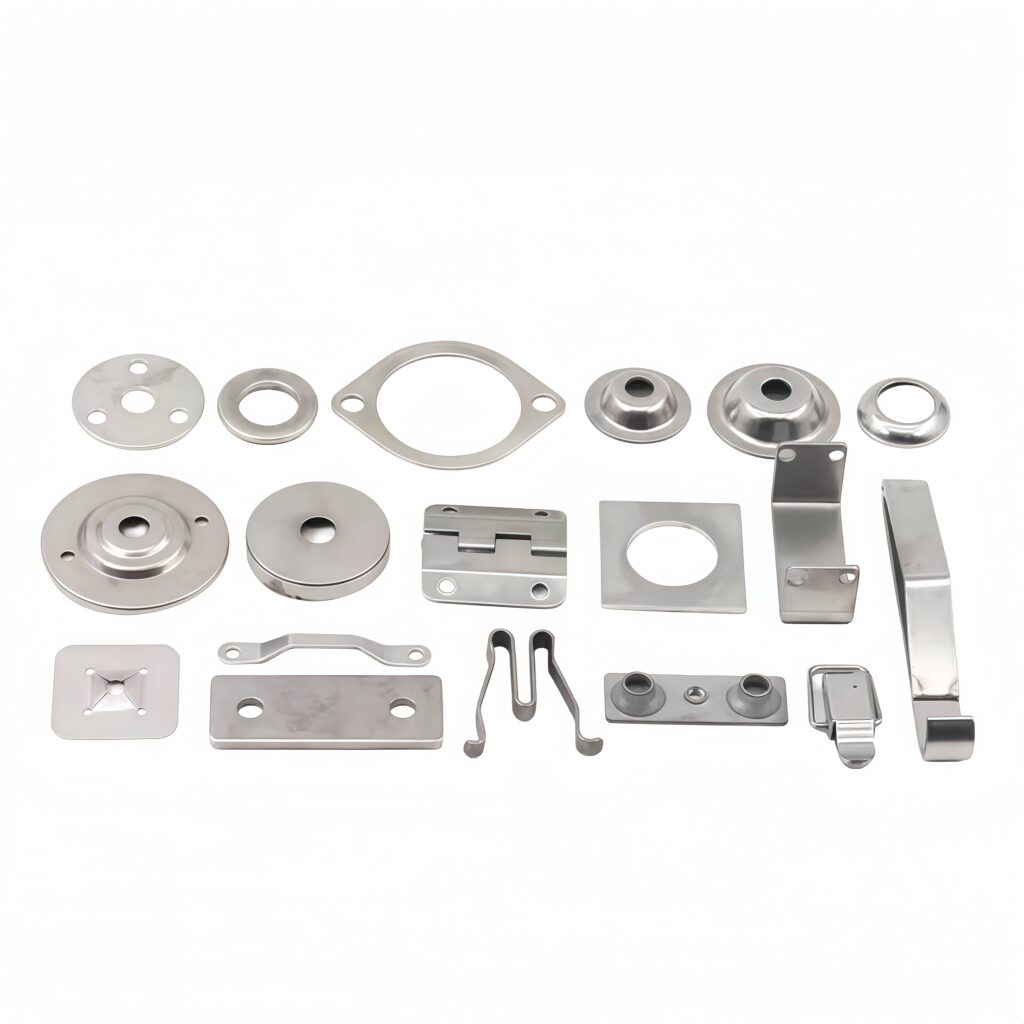
Aluminum 5052: A non-heat-treatable aluminum alloy, 5052 is known for its excellent ductility and corrosion resistance, making it a top choice for Deep Drawn Stamping and High-Precision Stamping applications. Its key Material properties include a Tensile strength of 230 MPa, a yield strength of 95 MPa, and exceptional ductility (25% elongation)—higher than 6061, making it ideal for complex stamping processes like Deep Drawn Stamping. The Surface finish of 5052 aluminum is smooth (Ra 0.3-1.0 μm when polished), similar to 6061, and its corrosion resistance is superior to 6061, though still less than Stainless steel 304 vs 316. This makes 5052 suitable for High-Precision Stamping applications where corrosion resistance is important but extreme coastal exposure is not a concern.
In High-Precision Stamping and Tight Tolerance Metal Stamping projects, 5052 aluminum excels in Deep Drawn Stamping, where its high ductility allows for complex, deep shapes without cracking—an advantage over 6061 and even some stainless steel grades. It is also compatible with Progressive Die Stamping and Precision Metal Punching, with a lower springback rate than stainless steel (Stainless steel 304 vs 316), which simplifies Stamping Tooling and Die Design. Its lower Tensile strength compared to stainless steel means that Stamping Tooling and Die Design can use softer, more cost-effective tooling materials, reducing overall project costs. When comparing 5052 vs 6061 for High-Precision Stamping, 5052’s superior ductility and corrosion resistance make it ideal for Deep Drawn Stamping, while 6061’s higher Tensile strength is better suited for parts requiring more structural rigidity. Both aluminum alloys have a lower Tensile strength than Stainless steel 304 vs 316, but their lightweight and lower springback rate make them valuable for Tight Tolerance Metal Stamping projects where weight is a critical factor.
Chapter 2: Springback Rate Comparison in High-Precision Stamping
⚠️ Engineer’s Tip: Managing Springback Rate
Springback is critical for Tight Tolerance Metal Stamping. Stainless steel (304/316) has a high springback rate (5-8%), requiring over-bending tooling. In contrast, Aluminum (5052) is much more stable (1-3%), allowing for more consistent dimensional accuracy in complex bends.
Springback rate is a critical factor in High-Precision Stamping and Tight Tolerance Metal Stamping, as it directly impacts part precision and dimensional accuracy. Springback occurs when a metal sheet elastically rebounds after being stamped, bending, or punched, leading to dimensional deviations from the desired shape. The springback rate varies significantly between materials, and understanding these differences is essential for Stamping Tooling and Die Design, as well as selecting the right material for your High-Precision Stamping project. Below is a detailed comparison of springback rate between Stainless steel 304 vs 316 and aluminum (6061/5052), along with how it influences stamping processes like Progressive Die Stamping, Deep Drawn Stamping, and Precision Metal Punching.
2.1 What is Springback Rate in High-Precision Stamping?
In High-Precision Stamping, springback rate refers to the degree to which a metal sheet rebounds elastically after being deformed by stamping operations (e.g., bending, punching, Deep Drawn Stamping). This rebound can cause the part to deviate from the desired dimensions, which is a critical concern for Tight Tolerance Metal Stamping projects. The springback rate is influenced by several factors, including Material properties (Tensile strength, ductility, yield strength), stamping process type (Progressive Die Stamping vs. Deep Drawn Stamping), and Stamping Tooling and Die Design. For engineers, managing springback rate is essential to ensuring part precision, and this requires a deep understanding of how different materials—Stainless steel 304 vs 316 and aluminum (6061/5052)—behave during High-Precision Stamping.
Materials with higher Tensile strength and lower ductility typically have a higher springback rate, as they are more resistant to permanent deformation. This is why stainless steel (Stainless steel 304 vs 316) has a higher springback rate than aluminum, requiring more advanced Stamping Tooling and Die Design to compensate. In Tight Tolerance Metal Stamping, even a small springback rate can lead to non-compliant parts, so selecting a material with a springback rate that aligns with your precision requirements is critical. Below is a detailed breakdown of springback rate for each material, along with how it impacts key stamping processes like Progressive Die Stamping, Deep Drawn Stamping, and Precision Metal Punching.
2.2 Springback Rate: Stainless Steel (304/316) vs. Aluminum (6061/5052)
When comparing the springback rate of Stainless steel 304 vs 316 and aluminum (6061/5052) in High-Precision Stamping, the key difference lies in their Material properties—specifically Tensile strength and ductility. Stainless steel has a higher Tensile strength than aluminum, which means it has a higher springback rate, while aluminum’s lower Tensile strength and higher ductility result in a lower springback rate. This difference directly impacts Stamping Tooling and Die Design, as well as the choice of stamping process (e.g., Progressive Die Stamping vs. Deep Drawn Stamping) for Tight Tolerance Metal Stamping projects.
Stainless Steel 304 Springback Rate: Due to its higher Tensile strength (515 MPa) and moderate ductility (40% elongation), 304 stainless steel has a springback rate of 5-8% for standard bends (90 degrees) in High-Precision Stamping. This means that after a 90-degree bend in Progressive Die Stamping or Deep Drawn Stamping, the part will rebound by 5-8 degrees, requiring Stamping Tooling and Die Design to over-bend the part to compensate. For Tight Tolerance Metal Stamping, this over-bending must be precise, as even a 1-degree deviation can lead to non-compliant parts. In Precision Metal Punching, the springback rate of 304 is less of a concern, but it still impacts hole precision, requiring careful punch-die alignment and clearance—key aspects of Stamping Tooling and Die Design.
Stainless Steel 316 Springback Rate: 316 stainless steel has a springback rate nearly identical to 304 (5-8% for 90-degree bends), due to its similar Tensile strength and ductility. The addition of molybdenum does not significantly affect springback rate, but it does enhance corrosion resistance, making it suitable for coastal High-Precision Stamping applications where springback rate management is still critical. For Tight Tolerance Metal Stamping projects using 316, Stamping Tooling and Die Design must include over-bending adjustments, similar to 304, to compensate for springback. In Deep Drawn Stamping, the springback rate of 316 can lead to dimensional deviations if not managed, so tooling must be optimized to maintain precision, especially for complex shapes.
Aluminum 6061 Springback Rate: Aluminum 6061 has a lower Tensile strength (310 MPa) and moderate ductility (12% elongation), resulting in a springback rate of 2-4% for 90-degree bends in High-Precision Stamping. This lower springback rate simplifies Stamping Tooling and Die Design, as less over-bending is required to achieve the desired shape. For Tight Tolerance Metal Stamping projects, this means more consistent dimensional accuracy, especially in Progressive Die Stamping and Precision Metal Punching. In Deep Drawn Stamping, the lower springback rate of 6061 allows for smoother, more precise shapes, with less risk of dimensional deviation. Compared to Stainless steel 304 vs 316, 6061’s lower springback rate is a significant advantage for High-Precision Stamping applications where tight tolerances are required.
Aluminum 5052 Springback Rate: Aluminum 5052 has a lower Tensile strength (230 MPa) and higher ductility (25% elongation) than 6061, resulting in an even lower springback rate of 1-3% for 90-degree bends. This makes 5052 ideal for Tight Tolerance Metal Stamping projects, especially those involving Deep Drawn Stamping and complex bends. The low springback rate of 5052 simplifies Stamping Tooling and Die Design, as minimal over-bending is needed to compensate for rebound. In Progressive Die Stamping and Precision Metal Punching, 5052’s low springback rate ensures consistent dimensional accuracy, making it a top choice for High-Precision Stamping applications where precision is non-negotiable. When compared to Stainless steel 304 vs 316, 5052’s springback rate is significantly lower, making it easier to achieve tight tolerances without complex tooling adjustments.
2.3 Managing Springback Rate in Stamping Tooling and Die Design
For High-Precision Stamping and Tight Tolerance Metal Stamping projects, managing springback rate requires careful Stamping Tooling and Die Design, tailored to the Material properties of the selected material (Stainless steel 304 vs 316 or aluminum 6061/5052). Below are key strategies for managing springback rate, based on material type, to ensure part precision and compliance with tight tolerances:
For Stainless Steel (304/316): Due to their higher springback rate (5-8%), Stamping Tooling and Die Design for Stainless steel 304 vs 316 must include over-bending dies, which bend the part slightly beyond the desired angle to compensate for rebound. For example, a 90-degree bend in Progressive Die Stamping or Deep Drawn Stamping would require a die angle of 82-85 degrees to achieve the desired 90-degree shape after springback. Additionally, using hardened tooling materials (e.g., D2 tool steel) and optimal punch-die clearance (10-15% of material thickness) helps reduce springback rate and improve precision. In Precision Metal Punching, using rounded punch tips can also minimize springback, ensuring hole dimensional accuracy for Tight Tolerance Metal Stamping.
For Aluminum (6061/5052): With a lower springback rate (1-4%), Stamping Tooling and Die Design can be simpler, but still requires careful consideration to maintain Tight Tolerance Metal Stamping. For 6061 and 5052, over-bending is minimal (1-3 degrees for 90-degree bends), and tooling materials like A2 tool steel are sufficient, as their lower Tensile strength reduces tool wear. In Deep Drawn Stamping, the low springback rate of aluminum allows for more complex shapes with less tooling adjustment, and Precision Metal Punching can be done with tighter punch-die clearance (5-10% of material thickness) to improve hole precision. For Tight Tolerance Metal Stamping projects using aluminum, the low springback rate is a key advantage, as it reduces the risk of dimensional deviations and simplifies quality control.
Regardless of the material selected (Stainless steel 304 vs 316 or aluminum 6061/5052), testing and prototyping are essential to fine-tune Stamping Tooling and Die Design for springback rate. This is especially critical for High-Precision Stamping and Tight Tolerance Metal Stamping projects, where even minor dimensional deviations can lead to part failure. By understanding the springback rate of each material and adjusting Stamping Tooling and Die Design accordingly, engineers can ensure consistent, precise parts across all stamping processes—Progressive Die Stamping, Deep Drawn Stamping, and Precision Metal Punching.
Chapter 3: Suitability for Coastal High-Salt-Fog Environments
Coastal high-salt-fog environments present unique challenges for High-Precision Stamping and Tight Tolerance Metal Stamping parts, as salt fog accelerates corrosion, leading to premature part failure, reduced durability, and compromised precision. Selecting a material with superior corrosion resistance is critical in these environments, and the choice between Stainless steel 304 vs 316 and aluminum (6061/5052) depends heavily on their Material properties—specifically corrosion resistance, Tensile strength, and Surface finish. This chapter explores how each material performs in coastal high-salt-fog environments, drawing on industry experience to help engineers make informed material selections for High-Precision Stamping projects.
3.1 Corrosion Mechanisms in Coastal High-Salt-Fog Environments
In coastal areas, salt fog (a mixture of saltwater droplets and air) causes two primary corrosion mechanisms: pitting corrosion and crevice corrosion. Pitting corrosion occurs when salt ions (chloride) penetrate the material’s surface, creating small, localized pits that can grow over time, compromising the part’s structural integrity and precision. Crevice corrosion occurs in tight gaps (e.g., between stamped parts or tooling) where saltwater becomes trapped, accelerating corrosion. For High-Precision Stamping and Tight Tolerance Metal Stamping parts, these corrosion mechanisms can lead to dimensional deviations, reduced Tensile strength, and surface degradation—all of which impact part performance.
The ability of a material to resist these corrosion mechanisms depends on its Material properties, including the presence of alloying elements (e.g., chromium, molybdenum), Surface finish, and Tensile strength. Stainless steel (Stainless steel 304 vs 316) contains chromium, which forms a protective oxide layer on the surface, while molybdenum (in 316) enhances this protection against chloride ions. Aluminum (6061/5052) forms a thin oxide layer, but it is less resistant to chloride-induced corrosion compared to stainless steel. Below is a detailed comparison of each material’s performance in coastal high-salt-fog environments, along with implications for High-Precision Stamping and Stamping Tooling and Die Design.
3.2 Material Performance in Coastal High-Salt-Fog Environments
Stainless Steel 304 in Coastal Environments: While 304 stainless steel offers good corrosion resistance in general environments, it is moderately resistant to coastal high-salt-fog environments. The 18% chromium content forms a protective oxide layer, but chloride ions from salt fog can penetrate this layer, leading to pitting corrosion over time. This is a critical concern for High-Precision Stamping and Tight Tolerance Metal Stamping parts, as pitting can reduce Tensile strength, compromise Surface finish, and lead to dimensional deviations. For example, in Progressive Die Stamping parts used in coastal marine applications, 304 may develop pits that affect the precision of punched holes or bent edges, requiring frequent maintenance or replacement.
Despite its limitations, 304 can be used in coastal High-Precision Stamping applications if additional corrosion protection is applied (e.g., passivation, coating). Passivation is a chemical process that enhances the protective oxide layer, improving resistance to pitting corrosion. The Surface finish of 304 also plays a role—polished Surface finish (Ra 0.2-0.4 μm) reduces the number of surface defects where salt ions can accumulate, slowing corrosion. However, for Tight Tolerance Metal Stamping parts in harsh coastal environments, 304 is often not the optimal choice, as its corrosion resistance is outperformed by Stainless steel 316.
Stainless Steel 316 in Coastal Environments: Stainless steel 316 is the gold standard for High-Precision Stamping and Tight Tolerance Metal Stamping parts in coastal high-salt-fog environments, thanks to the addition of molybdenum (2-3%) in its Material properties. Molybdenum enhances the protective oxide layer, making it highly resistant to chloride-induced pitting and crevice corrosion—critical for coastal applications. The Tensile strength and Surface finish of 316 are similar to 304, so it maintains the same precision and performance in stamping processes like Progressive Die Stamping, Deep Drawn Stamping, and Precision Metal Punching, while offering superior corrosion resistance.
In coastal High-Precision Stamping projects, 316 stainless steel can withstand long-term exposure to salt fog without significant pitting or corrosion, ensuring consistent Tensile strength, Surface finish, and dimensional accuracy for Tight Tolerance Metal Stamping parts. Stamping Tooling and Die Design for 316 is similar to 304, but its superior corrosion resistance means parts require less maintenance and have a longer service life. For example, Deep Drawn Stamping parts used in coastal marine equipment (e.g., sensors, fasteners) made from 316 maintain their precision and structural integrity for years, even in constant salt fog exposure. When comparing Stainless steel 304 vs 316 for coastal High-Precision Stamping, 316 is the clear choice for durability and precision.
Aluminum (6061/5052) in Coastal Environments: Aluminum (6061/5052) is less resistant to coastal high-salt-fog environments compared to stainless steel (Stainless steel 304 vs 316), due to its thinner protective oxide layer. Chloride ions from salt fog easily penetrate this layer, leading to pitting corrosion and surface degradation, which compromises Tensile strength and Surface finish—critical for High-Precision Stamping and Tight Tolerance Metal Stamping parts. While aluminum’s lightweight is an advantage for many applications, its poor corrosion resistance in coastal environments limits its use in High-Precision Stamping projects where durability and precision are non-negotiable.
Aluminum 5052 offers better corrosion resistance than 6061, thanks to its higher magnesium content, but it still cannot match the corrosion resistance of Stainless steel 304 vs 316. In coastal High-Precision Stamping, aluminum parts may require frequent coating or maintenance to prevent corrosion, which adds cost and complexity to Tight Tolerance Metal Stamping projects. For example, Precision Metal Punching parts made from 6061 aluminum in coastal applications may develop pitting within months, leading to dimensional deviations and reduced performance. While aluminum’s low springback rate simplifies Stamping Tooling and Die Design, its poor corrosion resistance in salt fog makes it unsuitable for long-term coastal High-Precision Stamping applications.
3.3 Recommendations for Coastal High-Precision Stamping
Based on industry experience and Material properties, the following recommendations will help engineers select the right material for High-Precision Stamping and Tight Tolerance Metal Stamping projects in coastal high-salt-fog environments:
- For long-term durability and precision: Select Stainless steel 316. Its molybdenum-enhanced corrosion resistance, high Tensile strength, and smooth Surface finish make it ideal for coastal High-Precision Stamping, including Progressive Die Stamping, Deep Drawn Stamping, and Precision Metal Punching. Stamping Tooling and Die Design should focus on managing its springback rate (5-8%) and using hardened tooling materials to ensure precision.
- For cost-effective, short-term coastal applications: Select Stainless steel 304 with passivation and a polished Surface finish. This will enhance its corrosion resistance, making it suitable for High-Precision Stamping projects where long-term exposure is limited. Stamping Tooling and Die Design should include over-bending to compensate for springback rate, and regular maintenance to monitor for pitting.
- Avoid aluminum (6061/5052) for long-term coastal High-Precision Stamping. While its low springback rate simplifies Stamping Tooling and Die Design, its poor corrosion resistance in salt fog will lead to premature part failure, compromised Tensile strength, and surface degradation—all of which are critical concerns for Tight Tolerance Metal Stamping.
For all coastal High-Precision Stamping projects, regardless of material, regular maintenance (e.g., cleaning, inspection) is essential to preserve Material properties, including Tensile strength and Surface finish, and ensure compliance with Tight Tolerance Metal Stamping requirements. Stamping Tooling and Die Design should also include corrosion-resistant materials (e.g., stainless steel tooling) to prevent tool degradation in salt fog environments.
Precision Stamping Material Comparison
| Material | Tensile Strength | Springback | Coastal Use | Best For |
|---|---|---|---|---|
| SS 304 | 515 MPa | 5-8% | Moderate | General B2B Hardware |
| SS 316 | 515 MPa | 5-8% | Excellent | Marine/Medical |
| AL 6061 | 310 MPa | 2-4% | Poor | Lightweight Structural |
| AL 5052 | 230 MPa | 1-3% | Fair | Deep Drawn Parts |
Chapter 4: Material Selection Comparison Table for High-Precision Stamping
To simplify material selection for High-Precision Stamping and Tight Tolerance Metal Stamping projects, below is a comprehensive comparison table of Stainless steel 304 vs 316 and aluminum (6061/5052), focusing on core keywords (Material properties, Tensile strength, Surface finish) and critical stamping-related factors, including springback rate, corrosion resistance, and compatibility with stamping processes like Progressive Die Stamping, Deep Drawn Stamping, and Precision Metal Punching. This table serves as a quick reference for engineers to evaluate which material aligns with their project requirements, including Stamping Tooling and Die Design considerations.
| Material (Grade/Alloy) | Key Material Properties | Tensile Strength (MPa, Min) | Surface Finish (Ra, μm) | Springback Rate (90° Bend) | Corrosion Resistance (Coastal High-Salt-Fog) | Compatible Stamping Processes | Stamping Tooling and Die Design Considerations | Ideal High-Precision Stamping Applications |
|---|---|---|---|---|---|---|---|---|
| Stainless Steel 304 | 18% Cr, 8% Ni; excellent ductility (40% elongation); good atmospheric corrosion resistance | 515 | 0.2-0.8 (polished) | 5-8% | Moderate (requires passivation for long-term use) | Progressive Die Stamping, Deep Drawn Stamping, Precision Metal Punching | Use hardened tooling (D2 steel); over-bend to compensate for springback; 10-15% punch-die clearance | General-purpose Tight Tolerance Metal Stamping; inland automotive/aerospace parts; non-coastal medical components |
| Stainless Steel 316 | 16% Cr, 10% Ni, 2-3% Mo; excellent ductility (40% elongation); molybdenum-enhanced corrosion resistance | 515 | 0.2-0.8 (polished) | 5-8% | Excellent (resistant to chloride-induced pitting) | Progressive Die Stamping, Deep Drawn Stamping, Precision Metal Punching | Use hardened tooling (D2/carbide); over-bend for springback; 10-15% punch-die clearance; corrosion-resistant tooling recommended | Coastal High-Precision Stamping; marine/aerospace parts; coastal medical equipment; Tight Tolerance Metal Stamping in harsh environments |
| Aluminum 6061 | Heat-treatable; moderate ductility (12% elongation); good atmospheric corrosion resistance; lightweight | 310 (heat-treated) | 0.3-1.0 (polished) | 2-4% | Poor (prone to pitting; requires coating) | Progressive Die Stamping, Precision Metal Punching, light Deep Drawn Stamping | Use A2 tooling; minimal over-bending; 5-10% punch-die clearance; lightweight tooling compatible | Inland High-Precision Stamping; lightweight automotive/aerospace parts; non-coastal Tight Tolerance Metal Stamping |
| Aluminum 5052 |