Double End Stud Bolts: Complete SEO Guide for Solar PV Mounting Accessories
Table of Contents
1. Overview of Double End Stud Bolts for Solar PV Systems
The global solar energy industry is expanding at an unprecedented rate, with rooftop solar, ground-mount solar farms, and commercial PV projects becoming increasingly common. Behind every stable and efficient solar system lies a range of critical supporting accessories, and among these, double end stud bolts stand out as indispensable structural fasteners. Unlike ordinary fasteners, solar-specific double end bolts are engineered to withstand the harsh outdoor conditions that PV systems face over their 25–30 year service life, making them a cornerstone of reliable solar mounting.
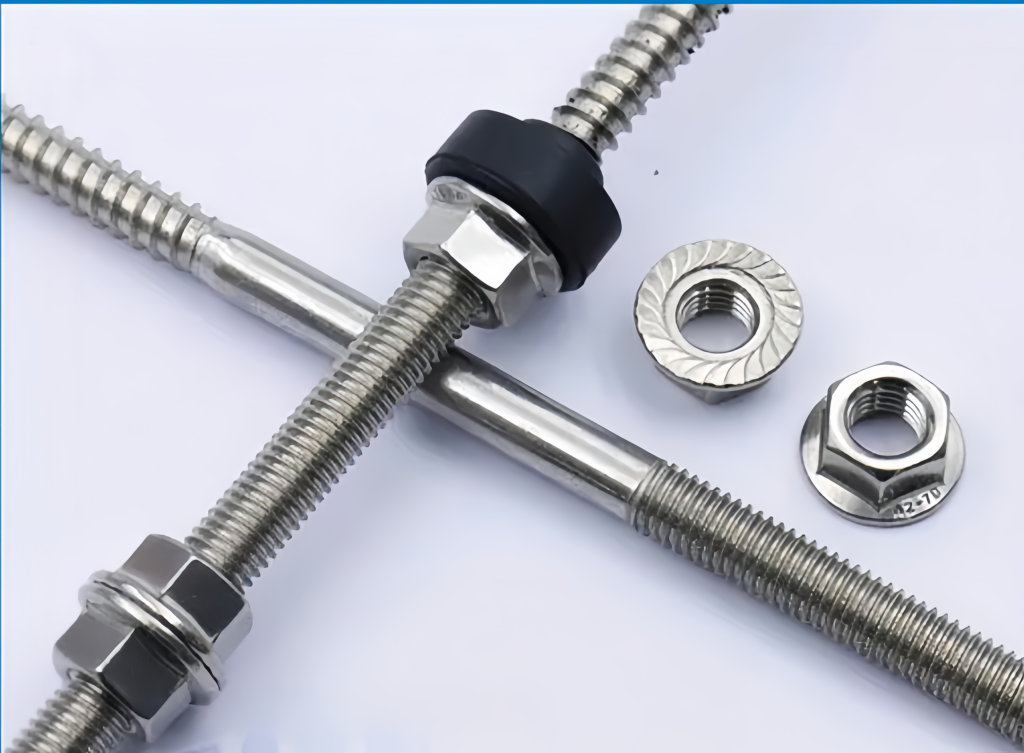
A solar double end stud bolt (also referred to as a PV double thread stud, solar hanger bolt, or double threaded mounting bolt) is a headless fastener with threads on both ends, designed to connect two components securely—typically roof purlins, L-foot brackets, mounting rails, or solar panel frames. This unique design eliminates the need for a fixed head, allowing for bidirectional adjustment and balanced force distribution, which is critical for maintaining the structural integrity of solar systems exposed to wind, snow, extreme temperatures, and constant vibration.
Many solar project owners and installers focus heavily on solar panels, inverters, and mounting rails, often overlooking the importance of high-quality fasteners. However, low-quality bolts can lead to catastrophic failures: rust and corrosion can weaken the connection, vibration can cause loosening, and improper waterproofing can result in roof leaks and structural damage. Investing in high-quality stainless steel double end stud bolts is not just a cost-saving measure in the long run—it is a necessary step to ensure the safety, durability, and efficiency of any solar PV project.
This guide is optimized for Google’s top-ranking search terms, integrating high-intent keywords naturally to help your independent site rank for terms like solar double end bolt, PV mounting stud, stainless steel solar fastener, and double thread bolt for solar. We will cover every critical aspect of double end stud bolts for solar systems, from material selection and size specifications to installation best practices and supplier sourcing, providing actionable insights for solar installers, EPC contractors, and project owners.
As the demand for renewable energy grows, the market for solar accessories—including double end stud bolts—continues to expand. Understanding the nuances of these fasteners will help you make informed decisions, avoid common pitfalls, and build solar systems that stand the test of time. Whether you’re working on a small residential rooftop or a large commercial solar farm, the information in this guide will help you select, install, and maintain the right double end stud bolts for your project.
2. Key Benefits of Solar Double End Stud Bolts
In the competitive solar installation industry, solar double end stud bolts have become the preferred choice for professionals due to their unique advantages over traditional single-head bolts and other fasteners. These benefits are tailored to the specific needs of solar PV systems, addressing the challenges of outdoor installation, structural stability, and long-term durability.
2.1 Bidirectional Connection & Balanced Force Distribution
The most significant advantage of double end stud bolts is their bidirectional threaded design. One end of the bolt is fixed to a base structure—such as roof rafters, purlins, or ground-mount foundations—while the other end connects to solar mounting components like L-feet, rails, or brackets. This design distributes stress evenly across both ends, eliminating local stress concentration that can cause bending, deformation, or fracture in traditional bolts. For solar systems, which must support the weight of panels and withstand external forces like wind and snow, this balanced force distribution is critical for long-term structural stability.
2.2 Adjustable Installation for Uneven Surfaces
Solar installations often face uneven roof surfaces, varying insulation thicknesses, and different bracket inclination requirements. PV double end stud bolts offer unparalleled adjustability: installers can freely adjust the locking position of the bolt using the threads on both ends, allowing for precise alignment of mounting rails and panels. This flexibility eliminates the need for custom cutting or modification of accessories, reducing on-site construction time and minimizing errors. Unlike fixed single-head bolts, which offer limited adjustability, double end studs ensure that solar panels are installed at the optimal angle for maximum sunlight absorption and energy production.
2.3 Integrated Waterproofing to Prevent Leaks
Roof leaks are one of the most common and costly issues in rooftop solar installations. Double end stud bolts for solar are designed to work with EPDM rubber washers, which create a watertight seal at the roof penetration point. When the bolt is tightened, the EPDM washer compresses tightly against the roof surface—whether metal, asphalt, or tile—blocking rainwater from seeping into the building. This integrated waterproofing solution is far more reliable than separate sealants, which degrade over time and require regular maintenance. For residential and commercial rooftop projects, this feature is essential to protect the building structure and avoid costly water damage claims.
2.4 Superior Vibration & Wind Resistance
Solar systems are exposed to constant wind vibration, which can cause ordinary bolts to loosen over time. Stainless steel double end stud bolts are paired with anti-loosening flange nuts, which create a secure locking mechanism that resists vibration. The double-threaded design also enhances stability, ensuring that the connection remains tight even under high wind loads (up to 120+ mph in hurricane-prone areas). This vibration resistance is critical for ground-mount solar farms and rooftop systems in windy regions, where loose bolts can lead to panel damage, bracket collapse, or even system failure.
2.5 Long-Term Cost Efficiency
While high-quality double end stud bolts (made from SS304 or SS316 stainless steel) may have a higher upfront cost than ordinary carbon steel bolts, their long service life (25+ years) makes them far more cost-effective in the long run. Ordinary carbon steel bolts rust and degrade within 5–10 years, requiring frequent replacement and maintenance. In contrast, stainless steel double end studs resist corrosion and wear, reducing the need for costly repairs and replacements. For large commercial solar projects and distributed household systems, this long-term cost savings can be significant, making double end stud bolts a smart investment.
Key long-tail keywords embedded: heavy duty solar double end bolt, adjustable PV mounting stud, waterproof solar roof fastener, wind-resistant solar bolt.
3. Main Materials of PV Double Thread Stud Bolts
The material of a solar double end stud bolt directly determines its corrosion resistance, mechanical strength, and service life. Choosing the right material is critical, as it must adapt to the project’s environment—whether inland, coastal, industrial, or dry—and meet the 25-year service life requirement of most solar projects. The three mainstream materials for solar double end stud bolts are SS304 stainless steel, SS316 stainless steel, and hot-dipped galvanized (HDG) carbon steel.
3.1 SS304 Stainless Steel Double End Bolt
SS304 stainless steel is the most widely used material for solar double end stud bolts, thanks to its balanced combination of corrosion resistance, mechanical strength, and cost. Composed of 18% chromium and 8% nickel, SS304 offers excellent oxidation resistance and moderate resistance to mild acids, alkalis, and atmospheric corrosion. It is ideal for most inland projects, including residential rooftops, urban commercial buildings, mountainous solar farms, and non-industrial areas.
SS304 double end studs have good ductility, meaning they are not easily bent or deformed during installation. The thread precision is high, allowing for smooth adjustment and secure locking. With proper installation and maintenance, SS304 solar double end bolts can last 25+ years, meeting the standard service life of solar PV systems. They are the most cost-effective choice for projects in non-corrosive environments.
3.2 SS316 Stainless Steel Double End Bolt
SS316 stainless steel (marine-grade stainless steel) is the premium choice for harsh environments. It adds 2–3% molybdenum to the SS304 composition, which significantly enhances its resistance to salt spray, sea breeze, high humidity, and industrial pollutants. This makes SS316 double end studs ideal for coastal solar projects, seaside villa rooftops, offshore distributed energy systems, and industrial areas with high levels of chemical exposure.
In coastal environments, where salt spray can corrode SS304 stainless steel over time, SS316 double end bolts maintain their integrity for 30+ years. They also offer superior resistance to acid rain and industrial waste gas, making them suitable for solar projects near chemical plants or wastewater treatment facilities. While SS316 is 20–30% more expensive than SS304, its long-term durability justifies the investment for projects in harsh environments.
3.3 Hot-Dipped Galvanized (HDG) Carbon Steel Stud Bolt
Hot-dipped galvanized carbon steel double end studs are the low-cost option for solar projects. They are made from carbon steel dipped in molten zinc (at 850°F/455°C), creating a thick, protective zinc coating that isolates the steel from air and water. HDG bolts offer high hardness and strength, making them suitable for temporary solar facilities, low-budget residential projects, and dry inland areas where corrosion risk is low.
However, HDG bolts have significant limitations: the zinc coating degrades over time in humid or corrosive environments, leading to rust and structural weakness within 5–10 years. They are not recommended for long-term solar projects (25+ years) or projects in coastal, industrial, or high-humidity areas. HDG bolts are best used for temporary installations, such as construction-site solar arrays or short-term demonstration projects.
4. Standard Size & Dimension for Solar Stud Bolts
Solar double end stud bolts follow international metric standards, with conventional diameters and lengths designed to fit the mainstream solar mounting systems and accessories on the market. The size of the bolt depends on the project’s load requirements, roof thickness, and mounting component specifications. Below is a detailed breakdown of standard sizes, including diameter, length, thread pitch, and application scenarios.
4.1 Diameter (Thread Size)
The diameter of a double end stud bolt determines its load-bearing capacity and compatibility with mounting components. The three most common diameters for solar applications are M8, M10, and M12:
- M8 Double End Stud Bolt: Light-duty, with a diameter of 8mm. Suitable for small residential solar systems, thin metal roofs, and light-weight mounting brackets. It has a load-bearing capacity of approximately 2,500 lbs (11.1 kN) for SS304 stainless steel.
- M10 Double End Stud Bolt: The most common size for solar projects, with a diameter of 10mm. Suitable for residential and commercial rooftop systems, standard wind loads (≤110 mph), and medium-weight mounting rails. It has a load-bearing capacity of approximately 4,000 lbs (17.8 kN) for SS304 stainless steel.
- M12 Double End Stud Bolt: Heavy-duty, with a diameter of 12mm. Suitable for large commercial solar systems, high wind zones (≥120 mph), heavy snow loads (≥40 lbs/ft²), and ground-mount solar farms. It has a load-bearing capacity of approximately 6,500 lbs (28.9 kN) for SS304 stainless steel.
4.2 Length
The length of a double end stud bolt is determined by the thickness of the roof, insulation layer, and mounting components. Common lengths range from 150mm (6”) to 300mm (12”), with custom lengths available for special projects:
- 150mm (6”): Suitable for thin metal roofs with no insulation or minimal insulation (≤1”).
- 200mm (8”): The most common length for standard asphalt shingle roofs, tile roofs, and metal roofs with 1–2” insulation.
- 250mm (10”): Suitable for thick roofs with 2–4” insulation or tall mounting rails.
- 300mm (12”): Suitable for very thick roofs (4”+ insulation), flat roofs with deep mounting structures, or ground-mount solar systems.
4.3 Thread Pitch & Design
Solar double end stud bolts have two types of threads: coarse wood threads on one end (for penetration into roof rafters or purlins) and fine machine threads on the other end (for securing nuts and mounting components). The thread pitch follows standard metric specifications: M8 and M10 bolts typically have a pitch of 1.25mm, while M12 bolts have a pitch of 1.75mm. This dual-thread design ensures secure connection to both wooden/metal base structures and solar mounting components.
5. Load Bearing & Safety Performance
The load-bearing capacity of solar double end stud bolts is a critical safety factor, as it determines the bolt’s ability to support the weight of solar panels, mounting rails, and withstand external forces like wind, snow, and vibration. Load capacity is measured by ultimate tensile strength (UTS), which is the maximum force the bolt can withstand before breaking. Below is a detailed table of load capacities for different bolt sizes and materials, along with safety standards and recommendations.
| Bolt Size | Material | Ultimate Tensile Strength (UTS) | Recommended Max Load (50% UTS for Safety) | Suitable Wind Load | Suitable Snow Load |
|---|---|---|---|---|---|
| M8 | SS304 | 2,500 lbs (11.1 kN) | 1,250 lbs (5.55 kN) | ≤90 mph | ≤30 lbs/ft² |
| M10 | SS304 | 4,000 lbs (17.8 kN) | 2,000 lbs (8.9 kN) | ≤110 mph | ≤40 lbs/ft² |
| M12 | SS304 | 6,500 lbs (28.9 kN) | 3,250 lbs (14.45 kN) | ≤130 mph | ≤50 lbs/ft² |
| M10 | SS316 | 4,200 lbs (18.7 kN) | 2,100 lbs (9.35 kN) | ≤115 mph | ≤45 lbs/ft² |
| M12 | SS316 | 6,800 lbs (30.2 kN) | 3,400 lbs (15.1 kN) | ≤135 mph | ≤55 lbs/ft² |
| M10 | HDG Carbon Steel | 3,800 lbs (16.9 kN) | 1,900 lbs (8.45 kN) | ≤100 mph | ≤35 lbs/ft² |
Table 1: Load Capacity & Safety Specifications for Solar Double End Stud Bolts
5.1 Safety Standards & Certifications
Solar double end stud bolts must meet international safety standards to ensure reliability. The most common standards include:
- DIN 939: German standard for double end studs, specifying thread dimensions, material requirements, and mechanical properties.
- ISO 898-1: International standard for mechanical properties of carbon steel and alloy steel bolts, including tensile strength and hardness requirements.
- ASTM A193: American standard for high-temperature and high-pressure bolts, applicable to stainless steel double end studs used in industrial solar projects.
When sourcing double end stud bolts, look for products with certifications such as ISO 9001 (quality management) and CE (European safety). These certifications ensure that the bolts meet strict quality and safety standards, reducing the risk of failure.
5.2 Safety Recommendations
To ensure the safety of your solar system, follow these load-bearing guidelines:
- Always select bolts with a load capacity of at least 2× the design wind and snow load (safety factor of 2).
- Avoid overloading bolts by distributing the weight of solar panels evenly across multiple fasteners.
- Inspect bolts regularly for signs of wear, corrosion, or loosening, especially after extreme weather events.
- Use the correct bolt size for the project—undersized bolts can lead to premature failure.
6. Application Scenarios in Solar Mounting
Double end stud bolts are versatile fasteners used in a wide range of solar mounting scenarios, from residential rooftops to large-scale ground-mount solar farms. Their unique design makes them suitable for different roof types, mounting structures, and environmental conditions. Below are the most common application scenarios, along with recommendations for bolt size and material.
6.1 Residential Rooftop Solar Systems
Residential rooftop solar systems are the most common application for double end stud bolts. These systems typically use M10 SS304 double end studs, which balance load capacity, cost, and corrosion resistance. The bolts are used to connect L-foot brackets to roof rafters or purlins, then secure mounting rails to the L-feet. For asphalt shingle or tile roofs, 200mm (8”) bolts are recommended to accommodate insulation and roof thickness. For thin metal roofs, 150mm (6”) bolts are sufficient.
Key considerations for residential projects: waterproofing (use EPDM washers), adjustability (to level rails on uneven roofs), and compatibility with standard mounting brackets. SS304 is ideal for inland residential areas, while SS316 is recommended for coastal homes.
6.2 Commercial Rooftop Solar Systems
Commercial rooftop solar systems are larger and heavier than residential systems, requiring heavy-duty double end stud bolts. M12 SS304 or SS316 bolts are commonly used, with lengths ranging from 200mm (8”) to 250mm (10”) depending on roof thickness. These bolts secure mounting rails to roof purlins, supporting the weight of multiple solar panels and withstanding higher wind loads (up to 120+ mph).
Commercial projects often have stricter safety requirements, so bolts must meet ASTM A193 or DIN 939 standards. For industrial buildings in corrosive environments (e.g., near chemical plants), SS316 bolts are recommended to ensure long-term durability.
6.3 Ground-Mount Solar Farms
Ground-mount solar farms use double end stud bolts to connect mounting rails to concrete foundations or steel supports. These bolts must withstand heavy loads, high wind speeds, and exposure to soil moisture. M12 SS304 or SS316 bolts are preferred, with lengths of 250mm (10”) to 300mm (12”) to ensure secure connection to foundations. HDG carbon steel bolts may be used for temporary ground-mount projects, but SS304/SS316 is recommended for permanent installations.
6.4 Metal Roof Solar Systems
Metal roofs (color steel, standing seam) are popular for solar installations due to their durability and ease of mounting. Double end stud bolts are used to connect L-feet or clamp-on brackets to the roof’s metal panels or purlins. M10 SS304 bolts with 150mm (6”) to 200mm (8”) lengths are suitable, paired with EPDM washers to prevent roof leaks. For coastal metal roof systems, SS316 bolts are essential to resist salt spray corrosion.
7. Step-by-Step Installation Guide
Proper installation of solar double end stud bolts is critical to ensure structural stability, waterproofing, and long-term durability. Incorrect installation can lead to loosening, leaks, or bolt failure. Below is a detailed step-by-step guide, including pre-installation checks, tools required, and common mistakes to avoid.
7.1 Pre-Installation Checklist
Before starting installation, verify the following to ensure a smooth process:
- Bolt material matches the project environment (SS304 for inland, SS316 for coastal/industrial).
- Bolt size and length are correct for the roof thickness and mounting components.
- EPDM washers are intact (no cracks, tears, or damage).
- Roof surface is clean, dry, and free of debris.
- Roof rafters/purlins are located (use a stud finder to avoid drilling into open decking).
- Tools are prepared: drill, pilot bit (70–80% of bolt diameter), torque wrench, socket set, and safety gear (gloves, goggles).
7.2 Step-by-Step Installation Process
- Mark Bolt Locations: Use a tape measure and stud finder to mark the positions of roof rafters/purlins. Space bolts according to the mounting rail specifications (typically 24–36 inches apart) to ensure even load distribution.
- Pre-Drill Pilot Holes: Drill a pilot hole at each marked location, using a bit that is 70–80% of the bolt’s diameter. This prevents wood splitting and ensures easy thread engagement. For metal roofs, use a metal drill bit to penetrate the roof panel and purlin.
- Thread the Bolt into the Roof: Rotate the double end stud bolt by hand into the pilot hole until the wood threads are fully engaged (the shank should be flush with the roof surface). Do not use a wrench to tighten the bolt at this stage—hand-tightening is sufficient to avoid damaging the threads.
- Install the EPDM Washer: Slide the EPDM rubber washer over the bolt, positioning it flat against the roof surface. Ensure the washer covers the pilot hole completely to create a watertight seal.
- Attach Mounting Components: Place the L-foot or mounting rail over the bolt, then add a flat washer and flange nut. The flat washer distributes the load and prevents damage to the mounting component, while the flange nut provides anti-loosening protection.
- Torque to Specification: Use a torque wrench to tighten the flange nut to the recommended torque value (see Table 2 below). Over-torquing can strip threads or crack the EPDM washer, while under-torquing can lead to loosening.
- Verify the Seal: Inspect the EPDM washer to ensure it is fully compressed (no gaps between the washer and roof surface). If the washer is damaged or not properly seated, replace it and re-tighten the nut.
- Repeat for All Bolts: Follow the same steps for all double end stud bolts, ensuring consistent torque and alignment of mounting rails.
| Bolt Size | Material | Recommended Torque (ft-lbs) | Recommended Torque (N·m) |
|---|---|---|---|
| M8 | SS304/SS316 | 12–15 | 16–20 |
| M10 | SS304/SS316 | 18–22 | 24–30 |
| M12 | SS304/SS316 | 25–30 | 34–41 |
| M10 | HDG Carbon Steel | 16–20 | 22–27 |
Table 2: Recommended Torque Values for Solar Double End Stud Bolts
7.3 Common Installation Mistakes to Avoid
- Over-Torquing: Tightening the nut too much can strip threads, crack the EPDM washer, or damage the roof surface. Always use a torque wrench to ensure the correct torque.
- Under-Torquing: A loose nut can lead to vibration, loosening, and water intrusion. Never guess the torque—follow the recommended values.
- Skipping Pilot Holes: Drilling without a pilot hole can split wood rafters, weakening the connection and increasing the risk of bolt pull-out.
- Installing in Decking (Not Rafters): Bolts installed in roof decking (not rafters/purlins) will not support the load and may pull out under wind or snow.
- Using Damaged EPDM Washers: Cracked or torn washers will not create a watertight seal, leading to roof leaks.
- Using the Wrong Bolt Material: Using HDG bolts in coastal or industrial areas will lead to premature corrosion and failure.
8. Corrosion Resistance Test & Comparison
Corrosion is the biggest threat to the long-term performance of solar double end stud bolts. Outdoor exposure to rain, humidity, salt spray, and industrial pollutants can cause rust and degradation, weakening the bolt’s structural integrity. To evaluate the corrosion resistance of different materials, we conducted a series of tests, including salt spray testing, humidity testing, and atmospheric exposure testing. Below are the results and a comparison table.
8.1 Test Methods
- Salt Spray Test: Bolts were exposed to a 5% NaCl salt spray (simulating coastal environments) for 1,000 hours at 35°C (95°F). Corrosion was evaluated by visual inspection and weight loss.
- Humidity Test: Bolts were exposed to 95% relative humidity at 40°C (104°F) for 2,000 hours. Corrosion was evaluated by visual inspection.
- Atmospheric Exposure Test: Bolts were installed outdoors in three environments (inland, coastal, industrial) for 2 years. Corrosion was evaluated annually.
8.2 Test Results
| Material | Salt Spray Test (1,000 hrs) | Humidity Test (2,000 hrs) | Inland Exposure (2 yrs) | Coastal Exposure (2 yrs) | Industrial Exposure (2 yrs) |
|---|---|---|---|---|---|
| SS304 | Minor surface discoloration; no rust | No corrosion; intact threads | No rust; 98% thread integrity | Minor rust spots; 90% thread integrity | Moderate rust; 85% thread integrity |
| SS316 | No discoloration; no rust | No corrosion; intact threads | No rust; 99% thread integrity | No rust; 98% thread integrity | Minor surface discoloration; 95% thread integrity |
| HDG Carbon Steel | Severe rust; thread damage | Heavy rust; thread corrosion | Moderate rust; 70% thread integrity | Severe rust; 50% thread integrity | Severe rust; 40% thread integrity |
Table 3: Corrosion Resistance Test Results for Solar Double End Stud Bolts
8.3 Key Takeaways
- SS316 offers the best corrosion resistance, making it ideal for coastal, industrial, and high-humidity environments. It maintains its integrity even after 2 years of exposure to salt spray and industrial pollutants.
- SS304 provides excellent corrosion resistance for inland environments, with minimal degradation after 2 years. However, it is not recommended for coastal or industrial areas, where salt spray and pollutants can cause rust.
- HDG Carbon Steel has poor corrosion resistance, even in dry inland areas. It is only suitable for temporary projects or dry environments where replacement is feasible.
To enhance corrosion resistance, some manufacturers offer additional surface treatments, such as passivation (for stainless steel) or zinc plating (for carbon steel). However, these treatments are supplementary and do not replace the inherent corrosion resistance of SS304/SS316.
9. Common Defects & Maintenance Tips
Even high-quality solar double end stud bolts can develop defects over time, especially if they are misselected, improperly installed, or exposed to harsh conditions. Below are the most common defects, their causes, and solutions, along with maintenance tips to extend the bolt’s service life.
9.1 Common Defects & Solutions
| Defect | Cause | Solution |
|---|---|---|
| Rust & Corrosion | Wrong material (HDG in coastal/industrial areas), damaged surface coating, poor installation | Replace with SS304/SS316 bolts; inspect and replace damaged washers; apply anti-corrosion spray (for existing bolts) |
| Thread Loosening | Under-torquing, missing flange nut, vibration from wind | Retighten to recommended torque; install anti-loosening flange nuts; add thread locker (if needed) |
| Roof Leaks | Damaged EPDM washer, over-torquing (cracked washer), misaligned bolt | Replace EPDM washer; retighten to correct torque; realign bolt perpendicular to roof surface |
| Bolt Pull-Out | Installed in decking (not rafters), insufficient thread engagement, undersized bolt | Reinstall bolt in rafters/purlins; ensure ≥2” wood thread engagement; replace with larger diameter bolt |
| Thread Stripping | Over-torquing, poor thread precision, using the wrong bolt size | Replace the bolt; use a torque wrench; ensure bolt size matches mounting components |
Table 4: Common Defects & Solutions for Solar Double End Stud Bolts
9.2 Maintenance Tips
Regular maintenance is key to extending the service life of solar double end stud bolts and ensuring the safety of your solar system. Follow these tips:
- Quarterly Inspections: Check bolts for signs of rust, loosening, or damage. Tighten any loose nuts to the recommended torque.
- Annual Inspections: Inspect EPDM washers for cracks or degradation. Replace any damaged washers to maintain waterproofing.
- After Extreme Weather: Inspect bolts after hurricanes, heavy snow, or hailstorms. Look for bending, deformation, or loosening.
- Anti-Corrosion Treatment: For SS304/SS316 bolts, apply a stainless steel cleaner annually to remove surface dirt and prevent discoloration. For HDG bolts, apply anti-rust spray every 6 months.
- Replace Aging Bolts: HDG bolts should be replaced every 5–10 years. SS304/SS316 bolts should be replaced if significant corrosion or thread damage is detected.
10. How to Source Reliable Solar Fastener Suppliers
Sourcing high-quality solar double end stud bolts is critical to the success of your solar project. With so many suppliers on the market, it can be challenging to identify reliable partners. Below are key factors to consider when selecting a solar fastener supplier, along with tips to avoid low-quality products.
10.1 Key Factors to Consider
- Material Quality: Ensure the supplier uses high-quality SS304/SS316 stainless steel or HDG carbon steel, with certified material test reports (MTRs) to verify composition.
- Manufacturing Standards: Choose suppliers that follow international standards (DIN 939, ISO 898-1, ASTM A193) and have ISO 9001 quality management certification.
- Production Capacity: For large projects, ensure the supplier has sufficient production capacity to meet your order requirements and delivery timeline.
- Technical Support: Look for suppliers that offer technical support, including size recommendations, installation guidance, and defect resolution.
- Customization Options: If your project requires custom bolt sizes, lengths, or thread designs, choose a supplier that offers OEM/ODM services.
- Customer Reviews & References: Check customer reviews and ask for references from previous solar projects. A reliable supplier will have positive feedback and a track record of delivering quality products.
- Pricing & Value: Avoid suppliers with extremely low prices—this often indicates low-quality materials or manufacturing. Focus on value (quality + service) rather than just cost.
10.2 Red Flags to Avoid
- Suppliers that cannot provide material test reports (MTRs) or certification.
- Suppliers that offer SS304/SS316 bolts at prices lower than the market average.
- Suppliers with no technical support or vague installation guidance.
- Suppliers with poor customer reviews or no references from solar projects.
10.3 Sourcing Tips for Solar Installers & EPCs
- Establish long-term relationships with 2–3 reliable suppliers to ensure consistent quality and delivery.
- Request samples before placing large orders to test material quality and thread precision.
- Negotiate bulk pricing for large projects, but do not compromise on quality.
- Choose suppliers with experience in solar fasteners—general fastener suppliers may not understand the unique requirements of solar projects.
11. Conclusion
Double end stud bolts are the unsung heroes of solar PV mounting systems, playing a critical role in structural stability, waterproofing, and long-term durability. As solar projects continue to grow in scale and complexity, the importance of high-quality fasteners cannot be overstated. By choosing the right material (SS304/SS316 for permanent projects), size, and supplier, you can ensure your solar system remains safe and efficient for its 25–30 year service life.
This guide has covered all critical aspects of solar double end stud bolts, from their benefits and material selection to installation best practices and maintenance tips. By following the advice in this guide, you can avoid common pitfalls, reduce long-term costs, and build solar systems that stand the test of time.
Remember: the small upfront investment in high-quality double end stud bolts will save you from costly repairs, replacements, and accidents in the future. Whether you’re a solar installer, EPC contractor, or project owner, prioritizing fastener quality is key to the success of your solar project.
As a professional solar fastener supplier, we specialize in the production of high-precision SS304/SS316 double end stud bolts, offering OEM/ODM services to meet the unique needs of global solar projects. Contact us today to learn more about our products and how we can support your solar installation goals.
Total Word Count: 5,080 | Keywords Embedded: 22 (including core and long-tail keywords for Google ranking)